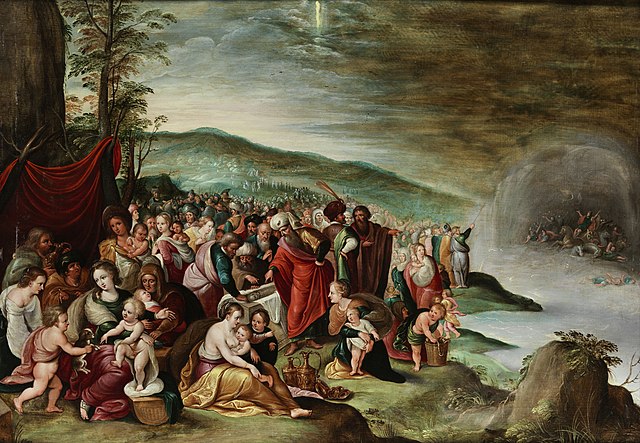
“…between Migdol and the Sea…”

Vincent Malo, “Moses Parting the Red Sea” (1631)

When Pharaoh let the people go, God did not lead them on the road through the Philistine country, though that was shorter…God led the people around by the desert road toward the Red Sea…By day the LORD went ahead of them in a pillar of cloud to guide them on their way and by night in a pillar of fire to give them light, so that they could travel by day or night. Neither the pillar of cloud by day nor the pillar of fire by night left its place in front of the people.

Then the LORD said to Moses, “Tell the Israelites to turn back and encamp near Pi Hahiroth, between Migdol and the sea. They are to camp by the sea, directly opposite Baal Zephon. Pharaoh will think, ‘The Israelites are wandering around the land in confusion, hemmed in by the desert.'”…So the Israelites did this.

When the king of Egypt was told that the people had fled, Pharaoh and his officials changed their minds about them…So he had his chariot made ready and took his army with him…The LORD hardened the heart of Pharaoh king of Egypt, so that he pursued the Israelites–all Pharaoh’s horses and chariots, horsemen and troops–pursued the Israelites and overtook them as they camped by the sea near Pi Hahiroth, opposite Baal Zephon.

Exodus 13:17-14:9

This story is so compelling to me. In case you don’t immediately know the context, this is the set-up for the Red Sea crossing in the book of Exodus. What’s so compelling to me about this story is how God orchestrates every single detail of it. And it makes absolutely no sense. [Well, unless God intends to do something so incredibly mind-blowing you never would believe it.].

If we were to speak in simple militaristic terms, God leads the Israelites into a trap. Then God Himself springs the trap that, apparently, He Himself has set. Do you see that? The Israelites are on their way out of Egypt, and then God tells them to … wait for it … Turn. Around. Then God tells them to go to a very specific place, “between Migdol and the sea.” We don’t know exactly what this place “Migdol” refers to, but in Hebrew the word means “tower” (presumably a fortified place). This specific place is near Pi Hahiroth and opposite Baal Zephon––again, two places where we don’t know the precise locations. But God wants them to camp by the sea. And apparently, there’s only one way out of this place, which is back the way they came.

At this point, the author says that God hardened the heart of Pharaoh so that he and his army would chase the Israelites. God explicitly says what Pharaoh and his officials will think. The Egyptians observe that the Israelites have gone to a place that they can’t get out of, because they are “hemmed in by the desert.” So the Israelites are encamped by the sea with the desert all around, and then they see the Egyptians blocking the only route of escape.

Every single one of these happenings and events are directly orchestrated by God. The author is very careful to tell us this. The Israelites have been following God, exactly like they’re supposed to do. And they are trapped. Trapped “between Migdol and the sea.” The story continues…

As Pharaoh approached, the Israelites looked up, and there were the Egyptians marching after them. They were terrified and cried out to the LORD.

Exodus 14:10

[Of course, you know how the story progresses. The Israelites complain to Moses. Moses cries out to God. God tells Moses to lift up his rod and tells the people to go forward, then God divides the waters and the Israelites cross the sea on dry land. The Egyptian army pursues them into the sea and are swallowed by the abyss when the waters return to their normal state.]

But I’ve stopped the story at this exact point for a reason. The Israelites are terrified, understandably so. The Israelites cry out to God, and so they should. God is the one who got them into this mess in the first place! [Except it’s not a mess. It simply appears that way in the moment. But I’m getting ahead of myself again!] What I want to point out here at this precise moment in the story is how terrifying this mode of travel is. The Israelites are, literally, “following God.” Into the desert. Into the unknown. Into certain death, for they know that they will all die eventually. Pause a moment.

Now fast forward…across the Red Sea to the foot of Mt Sinai, where the Israelites camped for over a year before they continue their journey home…

This is how it continued to be…Whenever the cloud lifted from above the Tent, the Israelites set out; wherever the cloud settled, the Israelites encamped. As long as the cloud stayed over the tabernacle, they remained in camp. When the cloud remained over the tabernacle a long time, the Israelites obeyed the LORD’s order and did not set out. Sometimes the cloud was over the tabernacle only a few days; at the LORD’s command they would encamp, and then at his command they would set out. Sometimes the cloud stayed only from evening till morning, and when it lifted in the morning, they set out. Whether by day or by night, whenever the cloud lifted, they set out. Whether the cloud stayed over the tabernacle for two days or a month or a year, they Israelites would remain in camp and not set out; but when it lifted, they would set out. At the LORD’s command they encamped, and at the LORD’s command they set out.

Numbers 9:16-23

This paragraph clearly communicates that this literal practice of “following God” was the normative mode of travel for the Israelites from the time they left Egypt until the time they entered their ancestral homeland about 40 years later. When God took a step, the Israelites took a step. When God stopped, the Israelites stopped. When God turned right, the Israelites turned right. When God turned left, the Israelites turned left. When God went up over the mountains, the Israelites went up over the mountains. When God famously went through the Rea Sea, the Israelites also went through the Red Sea.

As Christians, we often conceptualize the spiritual life as a journey of inner transformation, and that is wholly appropriate. Most of the New Testament is concerned with this very thing…how the people of God should be inwardly formed more into the likeness of Jesus. Over time, we should grow in love, joy, peace, patience, kindness, gentleness, goodness, faith, meekness, self-control, etc. But if we see this journey of the Israelites through the desert as somehow instructive for our spiritual life as Christians, then there is more to it than simply an internal journey. We can see some external evidence of inner change taking place among the Israelites as they travel through the desert. But the journey through the desert is equally external as well as internal, as demonstrated by this mode of travel. We can say in a very literal sense that the Israelites “walked about with God,” which is the phrase the author of Genesis uses to describe both Enoch (Gen 5:22) and Noah (Gen 6:9). God determined the actual path they traveled through the desert.

Now let’s fast forward again…this time all the way through the incarnation, resurrection, and ascension of Jesus to St Paul the apostle writing his letter to the Romans…

Therefore, there is now no condemnation for those who are in Christ Jesus, because through Christ Jesus the law of the Spirit of life set me free from the law of sin and death…[God’s Son] condemned sin in sinful man, in order that the righteous requirements of the law might be fully met in us, who do not live according to the sinful nature but according to the Spirit…Those who live in accordance with the Spirit have their minds set on what the Spirit desires. The mind of sinful man is death, but the mind controlled by the Spirit of life is life and peace…You, however, are controlled not by the sinful nature but by the Spirit, if the Spirit of God lives in you…Therefore, we have an obligation––but it is not to the sinful nature, to live according to it. For if you live according to the sinful nature, you will die; but if by the Spirit you put to death the misdeeds of the body, you will live, because those who are led by the Spirit of God are sons of God.

Romans 8:1-14 (emphasis added)

The Israelites were led by the Spirit of God. They thought they were going to die. But they lived.

The Christian spiritual life means to keep in step with God’s Holy Spirit. When He steps, we step. When He turns right, we turn right. When He turns left, we turn left. When He stops, we stop. St Paul is primarily talking about internal transformation here, but he uses a metaphor grounded in the Israelite story of the Old Testament. To walk in accordance with the Holy Spirit means to be led by Him, even controlled by Him. It’s not only internal transformation; it’s external direction as well.

Here’s the moral of the story. If you ever find yourself “between Migdol and the sea,” and you feel terrified because the Egyptians are bearing down upon you, cry out to God. Perhaps, like the Israelites, He Himself led you there. It’s not a mistake. Trust God.

Or, perhaps more likely, you fear to “walk about with God” because God might lead you into that very place––”between Migdol and the sea.” If that is you, cry out to God. Take courage. Follow God, and you will live.

“Waiting for the other shoe to drop”

Q: I have noticed that, since taking a deep dive into the OT, I am wrestling with some tension around how God disciplined the Israelites. I feel suddenly like I need to “walk the line” or God will inflict consequence. I have always struggled with a performance based personality. In my head, I know God is loving, kind and merciful. I know God sent Jesus so we could live free. But I am having a hard time truly believing that as I work through the OT. It’s as if I feel as though I am being watched, and if I don’t do “right” in God’s eyes, that my family will become hurt or ill, or our business will suffer, etc. 

I don’t want to live as though I am always waiting for the other shoe to drop. I just want to rest in my faith, in God’s goodness and graciousness. I want to feel loved by God and to trust that I am not constantly being judged or criticized. Yet I don’t know how to get from here to there. If you have any insight or wisdom to share, I would greatly appreciate it. Thank you!

I feel honored that you would trust me to ask me about the emotional tension that you’re feeling.  You are certainly not alone, and, in fact, I truthfully think that the tension you are beginning to feel is a good thing and not a bad thing.  Because I don’t think it will last forever.  

There were two sentences in your question that stood out to me.  The first one was, “I feel suddenly like I need to ‘walk the line’ or God will inflict consequence.”  The second one was, “I don’t want to live as though I am always waiting for the other shoe to drop.”  In these two sentences particularly, I hear you wrestling with the discomfort of feeling like judgment is pending and saying, essentially, “This doesn’t feel good.  I don’t like this.”    Furthermore, I can recognize myself in some of what you are saying here.  I also have insecurities around my performance, and I often feel the self-imposed pressure to be perfect all the time.  I understand what you’re saying, from first-hand experience.  I have a cluster of thoughts in response.  

First, you’re perfectly normal to feel the way you feel. One of the primary messages of the Old Testament, starting from the very opening chapters, is that God judges sin.  We rightly stand under God’s judgment for the ways in which we trespass the boundaries that God has prescribed for us as human persons.  And, in fact, one day Jesus will come back to earth and judge us, all of us.  To extend your metaphor: the Scriptures say that a day is coming when the other shoe will, in fact, drop.  If that is true, then I think it means that there is something truthful about the fear and anxiety you feel about God judging you.  God is a just judge.  And if God judges us justly, we stand condemned.  In other words, I don’t think it is helpful to rationalize away fear of judgment.  Accept the fear, but listen to what God says to that fear.  Which brings me to the second point…

Secondly, as you read the OT, listen to what God says to people who feel afraid of judgment.  I would encourage you especially to pay close attention to how incredibly sloooooooooow God is to judge.  That’s what the sacrifices were all about.  God made a way for the people to receive a “stay of execution” over and over again until God sent Jesus to deal with the problem of sin once and for all.  [That’s what the book of Hebrews in the NT is all about!]  So take your fears of judgment to the Scriptures and hear what God says in response.  What God says in response is (paraphrasing): “My property is always to have mercy.”

Thirdly, apply the Gospel to your fears.  Take your fear to Jesus.  God has given Jesus the authority to judge.  Jesus is the one who is tasked with judging you.  He is also the same person who died and rose again to save you.  Jesus has promised that He will judge you.  You can’t escape it.  But Jesus also promises that, if you believe in Him, He will save you from that judgment.  You have no other hope.  Jesus promises to judge, but He also promises to save.  All we have to do is trust His promises.  Easier said than done, I know, but I think trusting in the promises of God really does bring comfort to our fearful and anxious hearts.

Those are my thoughts.  I hope it helps.  I’ll pray for you as you (and I, too) rest in Jesus.

Obedience, not sacrifice

Q: I’ve been reading 1 Samuel and got to the part in chapter 15 where Saul is disobeying God. Samuel says to him that submission and obedience is better than sacrifice.  I’m confused, because I feel like sacrifice IS obedience and submission. I never considered the hierarchy or that God prefers one over the other. What then would you say is the difference? What is it about obedience and submission that God desires more than sacrifice? Is it a heart condition? What is God truly after? 

1 Samuel 15 is a really interesting chapter, for many reasons.  God had unequivocally told Saul what to do, via Samuel the prophet.  God’s instructions were to kill the Amalekites along with all their belongings and possessions.  Saul did not obey.  Instead, he preserved the best sheep of the livestock and then reported to Samuel that the purpose was for sacrificing to God.  Maybe Saul was lying about that.  Maybe Saul was telling the truth.  We don’t know.   Samuel’s point in reply is that God does not take pleasure in the killing of animals for the sake of killing animals.  God takes delight in us heeding His voice.  Saul had his priorities mixed up.  In the end, he didn’t care very much about doing what God asked him to do.  And that’s why God rejected him as king.  Saul rejected the “word of Yahweh.”  Therefore, Yahweh rejected him from being king.

I wonder if the actual words “sacrifice” and “obedience” themselves are confusing the issue here.  Maybe think about the word “ritual” instead of the word “sacrifice.”  In reality, that’s what the sacrificial system was for the Israelites.  It was a series of elaborate religious rituals that reminded the people that the animals they were sacrificing were taking their place in receiving the judgment of Yahweh on account of sin…for one more day, one more week, one more month, one more year, etc., until Messiah could come and take the judgment permanently.  If you replaced the word “sacrifice” with “ritual”, would you still be as inclined to say that “ritual IS obedience and submission.”  

Think of your own religious rituals.  We all have them.  The Eucharist, for example.  If you took the Eucharist (or perhaps you call it “communion”) faithfully, every day, but then murdered someone once a week, what would be the moral value of your religious ritual?  Jesus commands us to celebrate the Eucharist.  You’re “obeying”, but only in a manner of speaking.  By murdering, you would be disobeying on a much grander scale, so much so that it would make your celebration of the Eucharist next to meaningless, if not wholly meaningless.  Granted, it’s an extreme analogy, but I did that on purpose to make the point.

In short, God desires that we do His will in the world.  God does not desire that we kill animals just for the sake of killing animals, or ingest some bread and wine just for the sake of ingesting bread and wine.

A Theological Conversation on Sexual Identity

Recently I sat down with a pastor acquaintance of mine to chat about an upcoming sermon on sexual identity. This pastor wanted to pick my brain as they prepared to preach, and we recorded our conversation. The pastor’s voice is in bold type, and my voice is in italics type. Enjoy!


In our church we’ve been doing a series through the book of Proverbs over about seven weeks, using proverbs as wise sayings.  Like it’s the end of the year with your family around the house and just talking about some wisdom and giving wisdom into certain issues.  We’ve touched on finances and sex and pornography, so it’s been those kinds of issues.  What I’m doing this week is talking about sexuality.  I’m doing sexual identity from the perspective that sexuality was created by God.  That we have a sexual identity which is not defined by what we have or what we desire or anything like that.  Rather, who we are in God is who we are, outside of those things. So what do our desires mean to our humanity?  The things we have, for instance, the gift mix that we have, the things that we’re born with, what do those things mean about our humanity?  And so, what are the things that are true about identity, regardless of how we feel, what we desire, or what we have.  Then, I would like to speak to the community about how then do we exist as a community with the reality that people are born with, you know, our biology.  How do we exist with the tension that is in Scripture?  Then, informing us to view the world this way and to view ourselves this way, but we’ve got these experiences that people have that seem to contradict what the Scriptures say.  How do we help people integrate into the community and accept them as being an extension of the image of God, even though they feel a particular way––they might be inclined to recognize themselves or identify in a particular way?  So in all of that, I think that the anchoring theme for me is identity.

And then I would like to give some good scriptural analysis for people.  Because I think a lot of people inherit beliefs or philosophies, but we don’t really understand how we actually look at the Scriptures around this issue. So I would appreciate input around the Old Testament.  There are people who just go, “It’s in the Old Testament.”  I’ve got friends within this community always complaining that their biggest barrier is that they feel like Christians pick and choose what they’re going to be passionate about.  That we’re going to stand on this issue, but there are so many other things, too!  There’s so many laws in the Old Testament that even if you try, you can’t appropriate them in the New Testament just by virtue of the fact that cultures change and so forth.  But when they’re speaking to Christians, they feel like Christians have this staunch approach to this one issue, but they don’t actually know why the other laws are not applicable, or even the ones that can be applicable feels like, “But why aren’t you doing this one?” because you could be.  

And finally, how do we catch God’s heart? Because another thing that I’ve experienced on the other side of these sermons is there’s the clarity of Scripture but God’s heart is not always translated.  It’s like “Here’s the line,” but what does that mean for people who feel on the other side of that line? I mean, I don’t think you can stay away from this topic being a campus missionary for as long as we have been.  But I think this is fairly new looking at it from an identity perspective and creating a framework to help people gain clarity around how they go about thinking about it.  For me as a preacher, I’m coming in on a Sunday, people are seeing these issues differently, and I want theological clarity for people.  Then I also want people who are in that community not to see themselves as people who need to do something to be seen as whole, to be seen as an extension of the image of God, so I think if I would summarize my goals that’s what I’m trying to do.

Wow, that sounds really good. I’m so glad!  So, if I can summarize what I hear you saying, you would like to focus your sermon especially on the idea of sexual identity or gender identity, and what is some sensical biblical thinking about that.  And then, how to communicate that not just in an academic headspace, but in a way that God’s passion and love really come through.  That’s what I hear you saying you want to do.  That’s fantastic.

So I definitely think that Genesis 1 is really important.  I don’t know what kind of theological background you’re coming from, or your specific church.  But I feel like, when it comes to biblical thinking about gender, that portion of Scripture is really important.  I’ll say that I myself grew up in a fundamentalist and patriarchal kind of upbringing.  And largely through my own study of the Scripture I have come to think that those perspectives are just wrong.  I think the picture of gender identity with God is that neither men nor women have a trump card in terms of the nature of God.  Both genders together exhibit the image of God.  Now I’m getting into more theology now as opposed to just exegesis, but I would say that the reason why we use male pronouns for God is because that’s what Jesus used.  It’s not because God is somehow intrinsically male or female.  Or, if you want to say it this way, it’s like God is both male and female at the same time.

Can I just ask you a question on that? I’ve heard some theology lectures where God is no longer referred to as he or she, but they say “God-self.”  So how do you bring clarity around that? I hear what you’re saying that Jesus refers to God as “he” but that God is neither he nor she.  What is the correct framework for that?

Yes, so again, this is a distinction that’s important for me as a theologian, and as a biblical exegete.  Theology and exegesis are not strictly the same thing.  Those are distinct disciplines, and theology goes further than exegesis does. At some point, your exegesis has to be founded on some presuppositions, and those presuppositions are your theology. It’s important for me to make that distinction, that this stuff we’re talking about right now has to do with one’s faith commitments about God.  Right, so you can’t exegete your way to your faith commitments about God necessarily.  At some point, all of us as Christians have to take what Scripture says, and then we choose what we believe about God. And this idea of gender identity is clearly in that realm of theology.  Christians do come to different conclusions about these things, and it’s not necessarily a matter of right or wrong.  Although, there is such a thing as good theology and bad theology. 

So, now that I’ve kind of clarified that disclaimer, I’ll keep talking.  So let me come back to another kind of faith commitment I have that I think is very important for theology.  I am a firm believer that the non-physical aspect of our being, or non-physical aspect of reality, is reflected in physical aspects of reality.  And I think that’s so important in all kinds of ways.  We as people, how God has created us, we are not disembodied.  We are not disembodied spirits that just happen to live inside a body.  At some point when we die, we will be a disembodied spirit outside a body.  But right now, we’re a whole being.  We have our spirit and our body, and you can’t really pull those apart.  There are all kinds of different ways that Christians have gone about trying to explain the differences between masculinity and femininity, and in the end I think most of those constructs are unsatisfying in terms of how the genders actually relate to one another. 

In a marriage relationship, at least, I think the male partner is the penetrating partner and the female partner is the penetrated partner.  And I think it’s the same in our relationship with God. This is my own thinking now.  I think that the reason why God uses masculine pronouns for himself in his revelation to us is to show that in our relationship with God, he is the one who penetrates us, we are not the ones who penetrate him. So that’s how I reconcile that in my own theology.  That’s my own personal thinking.  But I think we have to read the revelation of God in Scripture in light of this fundamental truth that is set forth at the very beginning, that the image of God is both genders together.  Neither one has a privileged position over the other.  Now I understand that we could get into some stuff in the New Testament about preaching and stuff like that, but we don’t need to do that right now.

The other thing that I would say is that this differentiation between “penetrating” and “penetrated” really only applies within a sexual relationship.  Apart from that, men and women really do stand on their own in God’s economy.  I don’t think the idea is scriptural that a woman is under her father’s authority until she gets married and then her authority transfers to her husband.  I think that is just bogus. All of us as Christians, we’re all under Jesus.  Jesus says, “All authority is mine.” We’re all under Jesus.  So those are my thoughts on Genesis and why I think Genesis 1 is so important.  But you said that your series is really in Proverbs?

Yeah, so the wisdom is drawn from Proverbs, but it’s obviously very difficult just to preach out of Proverbs.  Generally, I think the whole proverbs thing means just the wisdom literature around it.  And that’s what has allowed for conversation, the tone of the preaching has allowed it because we’re talking wisdom literature.  We’ve been able to take the posture that Proverbs has, sort of thinking around the Scripture to help how people think through things.  Because that’s what proverbs do: as you look at it, it’s not obvious, and so it goes.  So it’s been a nice way to see and hear preaching differently.

Do you have a specific passage that you’re focused on in Proverbs?

Not at the moment. Generally, what I do is to zoom out before I zoom in.  I’m currently in the zoomed out phase.  The reason why I thought it would be good to speak to you is because we just came out of the Proverbs series.  So…okay, what’s the appropriate way to use the book of Proverbs to tie in, or at least link, the concepts from Genesis 1 and Romans 1 to put it all together.

Right.  So let me ask you, what are you hoping to appropriate from Romans 1 specifically?

So the reason why I like Romans 1 is because it speaks about choosing to dishonor God.  And there are ways in which God removes himself when there’s that dishonor, where we’ve chosen something other than God.  What I’d like to do with Romans 1 is speak about how the ordering of our affections is important, right?  And when our affections are not ordered, our submission is not ordered, it has consequences.  It’s like society likes to order affections to our own lives, but there’s a reason for God’s order.  And that if we don’t subscribe to that order, this is what happens.  So I like Romans 1 for that.

Right.  Okay, so I’m just going to share thoughts that come to mind.  What is troubling, at least in a modern context with the current kinds of social debates about gender identity and sexual expression and stuff––one of the reasons why this is hard for Christians is because if you read the Bible, it is impossible to escape, and particularly in the New Testament. that our relationship with God affects what we do with our genitals.  The Bible is very clear about that.  Which makes perfect sense, right?  If it’s true that we are made in the image of God, and God has made us male and female.  And if our world has been marred by sin, it makes sense that sometimes those boundaries don’t work exactly the way that one might feel like they should.  I mean, things like gender dysphoria make sense in a biblical worldview.  God has created us male and female, and yet here we exist in a world that has been marred by sin.  It makes sense that those things would not always work perfectly.  But actually, thinking about the problem isn’t necessarily the issue, right? It’s how do we solve these problems? That’s what’s hard. But in the end, you cannot escape this fact that how we relate to God does, in fact, impact what we do with the male or female parts of our body.  Paul is very clear about this.

For my own self, I think the path of wisdom is to say that it is not my place to change others. I have people very close to me who are Christians and are homosexual.  How I have dealt with that, personally, is to say that it is not my place to change them.  It’s my place to love them.  I don’t condone homosexual behavior, I don’t think it’s in God’s will.  But at the same time, I think that there are more important things in our Christian expression.  I mean, I’m not just going to say to someone else, “I’m not going to talk to you” or “I’m not going to be your friend” just because you’ve come to a belief that homosexual expression is okay in your relationship with God.  If I got into an honest conversation, what I would say is that I don’t think homosexual expression matches what the Bible reveals. But at the same time, I would say that sexual ethics is an issue of theology.  It’s not really an issue of exegesis.  So it’s an issue of faith.  Yes, and another reason why it’s hard is because we have this big verse in Galatians where Paul says that, in Christ, there is no longer Jew or Gentile, or even male and female!  So we’re like, “Oh, what is Paul really saying about gender identity there?”  I don’t think he means it in a physical way.  I don’t think he means that just because I’m a Christian, that doesn’t make me not a man anymore.  I think what he means is something like, it’s often tempting for me as a man to just view myself as being a man and then, when I interact with women, to say, “Well, you don’t understand because you’re a woman.”  Basically, I think Paul’s point is that that kind of thinking for Christians is not allowed.  We’re not simply men and women anymore, we are all under Christ.  Even further, there is something going on in our person when we come to Jesus and the Holy Spirit begins his work in us.  My very manhood is, in fact, being changed.  I’m becoming a new man.

I’m reminded of Jesus’ story to the Sadducees. They ask him a question about the woman who marries seven different brothers and then eventually dies, whose wife will she be in heaven?  They’re trying to trap him because they believe there really is no such thing as a resurrection.  And he says no, you’ve got it all wrong.  In the eternal state, when we are with God, we won’t be married.  This kind of inter-dynamism of the two genders in the gift of marriage is God’s gift for us while we are living. But in the eternal state, there’s something else for us, like we really will be individual people in our relationship with God.

While all these things are true, I think the weakness of this is coming to some kind of strictly individualistic view of my relationship with God, which Paul is also very clear that that is not what’s happening.  The new self, the new man that God is making in me, as a Christian is not an individual identity, but is a communal identity. It’s all of us, as the body of Christ together.  I think all of these things are woven into this idea of gender identity.

Bringing my thoughts back to Romans now, I think you are right. It’s a principle of the world that what we sow is what we will reap.  What we do with our genitals is going to impact us either for better for worse, and I don’t know if anyone other than God is really in a position to know specifically what we deserve and what we don’t.  But I think it is biblical wisdom to say.  As a man, if I were to choose to sleep around, I would lose my marriage.  I think we are on safe ground to preach that from a pulpit.  I think the Bible is very clear that God has given us free will to make our own moral choices, but that we will reap the consequences of those choices for good or for ill.

Yes, so I have two questions on opposite ends. First, what is good news for the homosexual?  How do we preach good news to somebody who is in that position?  And then the second one is, as a community of faith, how do you walk with somebody faithfully, speaking directly to the person who finds themselves wrestling?  So, what is the good news for person individually, and then the other end as a community of faith, as the body?  How do we love faithfully?  I find it easier in my personal relationships than in relating to people as a pastor. Because in your personal relationships, you know what you think.  But when you have that pastoral role, or when people are in church and you’re thinking of yourself as a disciple maker, I think that community makes it a bit complicated.  I don’t find it to be complicated at all in my personal relationships. But I do find it to be complicated in the body.

That makes perfect sense, because in some ways that community is looking to you for answers and for guidance.

Yeah.

I’ll just let you know that I’m not a pastor now, and I’ve never served a church as a pastor.  So I’m only speaking from my experience as a Christian friend, a Bible teacher, a small group leader, a person who has preached occasionally but not specific pastoral experience.  I need to be forthcoming about that.  Let me ask you, is this a major issue in your church community?

It isn’t a place for conversation around it.  But what people can’t deny is that the pervasive culture is growing, like the pride experience, that whole thing is growing. And people don’t know how to engage, so they are just sort of hiding.  So I think I would be mostly speaking to our community of faith and rebuking them for their own identity idolatry.  So that’s another thing that’s strong in my heart, that we have our own identity altars that we worship.  And yet we say that this [homosexual] community has been wrong for doing the very thing that we do.  So that’s something that I will mention.  I think the the whole concept of identity is a strong one.  And to highlight that this is an identity issue and we all wrestle with that in different ways.  So I’m hoping that if people would see the ways in which they have their own identity idolatry, they’ll be able to walk more faithfully with others and see all of us as people who need Christ.  And it’s manifesting in different ways, but in a way, I can relate because I’m struggling to lay down my own altar, so I’m not expecting others to do something that I’m not doing myself, so I’m hoping to bring it from that perspective.

Okay, so these are a few thoughts I have.  It’s similar to the way that children are a gift from God.  Nothing more, nothing less, right?  None of us are promised children, which seems so counterintuitive.  It seems like having babies is just what we do. But actually, the Bible says that children are a gift from God, which means that if God chooses not to give us children, we are not really in a position to be angry with God about that.  Even though that, what I’ve just said, that’s really hard.  For someone who is not able to have a baby, that’s a really hard thing.  I’m not naïve to that.  There’s a sense of grief and, like, “That’s just not how it should be.”   We should have children.  You know what I mean?

Yes.

In a similar vein, sexual expression is also not a right God has given to us.  And this is true even in marriage.  I’m very convinced that God has given us our bodies and God has given us a gift of sexual expression, but that does not give us a license to break the boundaries of another person.  If my wife were to say to me, “I’m not having sex with you anymore,” I have to deal with that.

Yes, exactly.

I cannot stand on this, like, sexual right.  I really can’t.  Because her body is still her body.  This comes back to the faith commitment I have that the non-physical part of us is reflected in the physical part of us.  As people, we have boundaries, and it’s not okay to break them.  So I think that’s the first thing, and that’s really hard.  Or another thing, like, let’s say something happened to either me or my wife physically and we couldn’t have sex anymore, I still have to be married to her.  I’m not released from my vow.

Right, you are not released!

So I think that’s the first thing, and I think that’s a huge hurdle.

I love the heterosexual examples of the unfairness, because that’s the whole thing: “It’s not fair that I can’t express!”  So I appreciate the examples from the other way, that is the same unfairness.  Even in that unfairness it doesn’t change the standard of God and his expectation.

Right.  It is very tempting, even for me as a married man, to start being entitled.  But we can’t.  If we are to think of ourselves as creatures of God’s creation, made in his image, there’s no place for entitlement.  We have to acknowledge that, and we have to abide by that limitation.  But I think there’s another issue that’s more difficult.  For me, in my life, I have very, very, very seldom had any kind of homosexual urge.  It’s just not really a thing for me.  So I feel like this issue I’m about to talk about is something that really needs to be talked about by someone who does have same sex attraction.  I mean, I’ve basically been attracted to women all my life, and it’s not like I made this choice at some point to be attracted to women, I just am.  And there is solace for me, to be honest, knowing that this is actually a good thing.  This is a good part of me that actually God wants.  God wants us to get married and to have babies and to show communal love in a family, the way God himself exists in a community of love.  This is a wonderful thing! But if I were to flip it around and say, “I actually shouldn’t be attracted to women. What God wants me to do is to be attracted to men, not women,” that would be really hard. 

Yeah.

I mean, I’d be like, “But…”

“…I just don’t want to.”

Yeah. And in the end, for me as a person who struggles with lust in a heterosexual way, I think it’d be very difficult for someone who was different to hear that kind of message from me.  That doesn’t necessarily mean I shouldn’t say that message, but I think it does mean that I should be very, very careful.

And extremely compassionate.  Yeah.

And we see this kind of thing in how Paul in the New Testament talks about Christian living.  He advises men to hang out with each other and women to hang out with each other and to help each other.  He doesn’t say this explicitly, but I think his reason for that is that often across genders, we just don’t understand each other.  We think really differently, and it’s hard.  There are aspects of my wife’s spiritual life that I can say, “I hear that,” and I mentally assent to it, but I don’t really fully understand her experience.  And that makes it hard, particularly in our spiritual life, if she is going through things that I don’t really understand.  And I think it’s the path of wisdom for me to be with her, to listen, to pray with her, but to try to speak into that is just not helpful.  And it works the other way, too.  There are some times in my own spiritual life where I need a man’s perspective.

The other thing that is not lost on me is that there are some other aspects of our identity that exhibit similar dynamics, when you could always say to another person, “Well, you just don’t understand.”  We have this same dynamic with black vs white skin, or any kind of difference where there’s some kind of obvious physical distinction between me and another person that I can point to, that’s really clear.  It’s really tempting to use that to either take advantage of that difference somehow or to simply ignore the difference and dismiss the other person’s experience.  But neither of those are the path of wisdom.  Not gender, not race, not even an adult-child difference.  God has not given us the gift of our humanity in order for us to take advantage of each other or to ignore the fact that our differences exist.

I like speaking tension, so I am not always trying to resolve tensions.  Because I think in our attempt to resolve tensions we quickly want a black and white answer and a lot of it is resolved in community.  And I think that’s okay.  Yeah, so I can highlight the places of tension and say it’s on us to to read the word faithfully.  And to figure out how to resolve those tensions, I think every generation has that responsibility.  So I don’t see myself as responsible for making it all okay for everybody.

Yes, I think that’s good and healthy.

This is all good.  I think it’s clarity in thinking.  I gravitate more to the apologetic side of things, but I thought this would probably need a little bit more biblical frameworks than apologetics.

The other thing that you talked about is wanting to communicate the substance of God’s heart.  I think this is something that we can always say.  Regardless of who you’re attracted to, I think we can rightly say that the desire in all of us for intimate relationship with another human person, regardless of gender, that desire is actually good and wholesome and comes from God.  God wants us to connect with each other, and not just on a superficial level.  God wants us to be so close to another person that we would have sex with them. (I hope you understand that I’m using the term God’s “will” in a general sense there.)  I think that is comforting.  

So I got married when I was 29. Of my group of friends, I was one of the later ones to get married.  And there was a time of my life when I really prayed about whether God wanted me to be a monk and have that life. And for about six months I prayed about that.  And I kind of came to the end of that, and I was like, “No, being married and having a family is something I really want.”  And there were times in my life when, dealing with loneliness and sexual frustration, it was a comfort for me to say to myself, “You know, this thing is actually good, even though this is causing me a lot of frustration right now.”  It’s not pleasant to have sexual urges that you cannot fulfill, but I think it is comforting to know that the desire at the bottom of that is good.  If we are created in the image of God, and if the physical reflects the non-physical, then to have sex is not simply an animal act, but it really is about the desire to connect to another person, and that desire is good and right.  If God himself is three persons in one, then being united with another person is living out God’s community. I really do think that that’s tremendously important.  And that God wants that kind of relationship with us, too.  It’s not just with each other.  There is a sense in which God loves each of us enough that if God could have sex with us, he would.

Right, yes!  And when you speak about physical things that sometimes point to spiritual things, or the other way around.  For me, when I think of the the whole concept of “knowing” that is all throughout the Old Testament and that sometimes God uses that term for his deep intimacy with us.  So for me, I see that parallel of covenant and relationship with the Lord as well.   Okay, and then lastly Proverbs.

Right.  Proverbs is an interesting book because there’s a very strong sexual subtext in Proverbs but it’s almost all from a man’s perspective. The first nine chapters of Proverbs is where sexuality is explored the most.  It’s a series of conversations from a father to a son about who to marry.  And basically what this dad says is: When it comes right down to it, don’t go for the woman who wants to sleep with you, especially if she’s married already.  Don’t do it!  Instead, look for the woman who worships Yahweh has a good head on her shoulders.  That’s what you want.  Which is really interesting!  There’s all kinds of things that can be explored in that.  So if I were teaching on sexual identity centered around Proverbs, that’s probably where I would start.  With this notion that the advice a father gives to a son is don’t go for the woman who wants to sleep with you, but go for the woman who worships Yahweh and who thinks well and has good sense.  Oh, and I should say, the message from the father to the son is he also needs to worship Yahweh.  That’s a given.  But I think that kind of tension really does highlight what is healthy versus unhealthy masculinity and healthy versus unhealthy femininity.

In the end, what God wants for me as a man is to find my masculinity in him, not in a woman.  And that’s the temptation, right? That’s the lure of the woman who wants to sleep with me.  Aside from the physical pleasure and that it feels good, spiritually the lure is that I’m looking for validation of my manhood in that person or in that experience as opposed to finding the validation of my manhood in the fact that God has created me to be a man.  Does that make sense?  And I think that there are lots of things that you can explore in that.  I’ve never been a woman, of course, so I can’t speak from a woman’s perspective.  But I should think that it would only make sense that it would work a similar way for what drives a woman to be seductive or try to seduce a man.  I would imagine it’s a similar thing of trying to find validation of one’s own femininity in this other person or this experience as opposed to the fact that God has created her to be a woman.

I love that.  For me, I think that is the link I was looking for.  I was feeling like it was three different threads.

Yeah.  Oh, another thing.  I’ve heard women talk about reading Proverbs 31 and feeling very…

Exhausted.

…like “I can never live up to this,” you know?  But I don’t think that’s how an ancient woman would have read it.  I think an ancient woman would have read that chapter and said to herself, “Oh, I’m not just a bedroom performer, or a kitchen performer.  God wants me to be just as much a productive member of society as a man!”  Right?  That’s the picture of the woman in Proverbs 31.  She is equally as involved in the social community as the man is.

I love it.

And I think that’s the heart of God.  I don’t subscribe to this notion that Proverbs 31 is about Lady Wisdom.  I don’t think it’s painting a picture of wisdom, I just don’t agree with that. I think the book of Proverbs opens with this advice from a father to a son about the kind of woman he should look for to marry.  Then I think Proverbs 31 is kind of like the answer: You don’t want to marry the type of woman who is out to sleep with you but who is out to make their community a better place.  And I think that’s a really encouraging and wholesome message.

It is.  Yeah, it is.  I think also what’s nice is that the text has all the information.  Thank you so much. I really appreciate it. I think it would have taken me much longer to try and bring it all together.

Yeah, sometimes it helps just to talk things out!  Before we say goodbye, can I pray for you and for your sermon?

That sounds great. Thank you.  Thank you so much.

On exegesis, theology, and homosexuality

Q: I am a Christian and came across this documentary recently.  Like most everyone these days, I’m interested in the issue of same-sex relationships, especially since this is a “lightning rod” issue within global Christanity right now.  I know the traditional view of the Church, and I have read and continue to research the matter.  I would like to deepen my understanding of this matter and apply it to how I live my life as a Christian.  May I ask how you see this issue, and how did you come to that understanding?

Thank you for asking!  I’m honored that you would ask for my opinion about this, I do not take it lightly.  I hope that my response will demonstrate equal honor to you.  First of all, before going any further, let me affirm you that I think you are wise to “deepen your understanding of the matter and apply it to how I live my life as a Christian.”  Regardless of whether you are personally convinced one way or another about the issue, to approach conversations from a strident and rigidly dogmatic approach will probably not fulfill St Paul’s admonition to “if it is possible, as much as depends on you, live peaceably with all people” (Rom 12:18).  And especially for people like myself who move in theological circles, we probably need to do much more listening than talking in any conversations we are involved in.  Actually, that’s probably not bad advice for Christians as a whole.

I have watched the documentary, and I thought it was very well done!  Although, certainly the video was advocating a particular position on the issue at hand.  Homosexual expression within the Christian tradition is a very difficult issue, for all of the reasons that are given in the documentary.  Most all of the exegetical points raised are valid, in my opinion.  However, I would say that none of the arguments presented necessarily mean that the conclusion is correct.

To answer your question directly, I myself hold a traditional Christian view of sexual expression.  Having said that, let me also say that I know people who are practicing Christians and practicing homosexuals.  Personally, I am friends with astute theologians on both sides of this issue.  I’ve spent a lot of time thinking about this topic, as have many Christians all around the world.  I would add that this issue (as a theological issue, at any rate) is fairly confined to Protestant expressions of Christianity.  In Catholic and Orthodox expressions of Christianity, there is very little discussion here (as far as I know, at least).  According to my present understanding, both of those fellowships would denounce homosexual expression as not in accordance with God’s will, and would do so unapologetically.  [For a brief description of the Catholic position, see Laudato Si, III.155 (pg. 115).  You can visit this webpage to read a brief description of the Orthodox position.]  My point here is that worldwide, I’m not sure there is quite so much movement to bless same-sex romantic relationships as often seems portrayed in Western culture(s).  Yes, there are Christians who have changed their minds about this issue, but there are many Christians who have not.

Q: Are there any scholarly works that you feel help the modern church understand what Scripture says about this?

I personally have not come across much theological scholarly material on this topic, although I’m always looking for more, and I’ll gladly accept any and all referrals!  I suppose that theological publishers are hesitant to publish books that deal with this issue, but that’s merely a guess on my part.  This is a legitimate issue of theological debate right now, especially within the global Anglican communion.  And there are some books that have been published about the issue of homosexual expression within Christianity, both for and against. Two popular books that were published a number of years ago are Wesley Hill’s Washed and Waiting and Matthew Vines’ God and the Gay Christian.  Both of those books were written by Christians who identify as gay and come to different conclusions about homosexual expression within the Christian faith.  But I would not regard either of these books as serious theological or exegetical works, nor do I think they were intended to be.  Fundamentally, I think those are books about Christian spirituality and Christian living.  Two other books that are more thorough are Karen Keene’s Scripture, Ethics, and the Possibility of Same-Sex Relationships as well as Sarah Coakley’s God, Sexuality, and the Self. However, I would venture to say that neither side has dug deep enough yet into the presuppositions of their own arguments.  I think the global Church has a lot more work to do on this issue before it can be considered theologically “settled” to the satisfaction of modern Christianity.

Q: Hmmm…what do you mean by that?

Thanks for asking!  Well, to explain myself there, I’ll need to back up a bit.  So please bear with me on what might seem like a long-winded detour, but I’ll bring it back around.  As the documentary points out very well, I think we should avoid drawing simplistic conclusions about a difficult issue and minimizing others with expressions like, “The Bible says that…”. I feel like Christians (especially in the evangelical world, where the Bible is held very highly) often don’t like to admit it, but the actual truth of the matter is that no one ever reads Scripture from an unbiased perspective.  I suggest that EVERYONE is ALWAYS interpreting when we read the Bible.  The Scriptures were written in languages that no one has spoken for centuries!  We all come to the Scriptures as non-mother-tongue exegetes, so all of us are “second-language speakers,” at best.  This necessarily means that there is a vast interpretive gulf between us and the original author/audience.  We absolutely must acknowledge that if we are to handle the Scriptures responsibly and with any kind of intellectual honesty and integrity.  So rather than saying things like, “The Bible says,” I think we are much wiser to say things like, “My understanding of the Scripture is…” or “I believe that the biblical author here means…”. Statements like these are much more honest about what is actually happening when we read and teach the Scriptures.  And certain interpretations are more sound than others, to be sure.  We should layer our theology accordingly.

But here’s the thing.  The task of exegesis itself is not neutral.  That is, we actually do bring our theology to bear on our exegesis, and we have no other choice in the matter (whether we admit it or not).  For example, the Gospels record that Jesus held up a piece of bread and said, “This is my body” (Matt 26:26; Mark 14:22; Luke 22:19).  How do you interpret what Jesus meant by that?  Try as anyone might, I do not think there is any truly neutral way to exegete that statement.  I submit that, in the end, a person must choose what they believe Jesus meant.  Which means that it is not really an exegetical matter at all.  It’s a theological matter.  We believe what we choose to believe.  And the same is true about exegesis as a whole.  We interpret the Scripture according to whatever method(s) that we believe is the best, and that method affects our conclusions.  We should not pretend to be more than we are as exegetes.  Yes, our exegesis is, in fact, informed by our presuppositions about God and about truth.  We are wise to own up to that from the very beginning, and then get on with doing the very best exegesis that we can.

Now, I’m not going to delve deeply into the Scriptural passages at play here.  You (along with other Christians) can study the Scriptures for yourself and conclude what you believe in fellowship with the Holy Spirit and in accordance with Holy Scripture.  But I will say this.  If you read 1 Corinthians 6, which is perhaps the Pauline passage that deals most explicitly with sexual ethics, you should notice that St Paul does not treat sexuality as a moral code.  That is, St Paul does not appeal to some moral law that condemns certain sexual practices but allows others.  Rather, his entire moral argument proceeds something along this line: “You have been made one with Christ, so why are you sleeping with a prostitute?” (1 Cor 6:15).  In other words, his sexual ethic is derived logically from our new identity in Christ and not strictly prescriptively from textual evidence.  I think we are wise to pay attention to this.  St Paul could have quoted OT passages to say that sleeping with prostitutes is wrong.  But he did no such thing.  Rather, he said (paraphrasing): “Hey, you’re one with Christ now!  Why are you making yourself one with a prostitute?”  Almost as if the expected reply is: “Of course! That’s just silly!”  The fact that St Paul NEITHER appeals to prescriptive Scripture (as does the “heterosexual” camp, usually) NOR appeals to science or culture or knowledge (or any of the other things that the “homosexual” camp does) should be instructive to us, I think.  That’s what I’m referring to when I say that I think the global Church has a lot more work to do on this issue before it can be considered theologically “settled.”  I have yet to see theological or exegetical studies that (I think) sufficiently take into account the way that St Paul treats sexual ethics in Holy Scripture and then work it out in what I would consider a satisfactory way in modern Christianity.

Q:  I’m not sure I fully understand yet.  When you say, “We believe what we choose to believe, and the same is true about exegesis as a whole,” are you referring to situations where people choose material, techniques and sources to back up what they want to believe?  Wouldn’t that deem this a futile exercise, especially when it comes to matters that are gray?

Right, I think you have understood me correctly.  I’m suggesting that a person can start with a certain set of presuppositions about God and about truth and then exegete their way to concluding that homosexual expression is OK for Christians.  Another person can start with some other presuppositions about God and about truth and then exegete their way to concluding that homosexual expression is NOT OK for Christians.  If this is true (and I would say that is what is happening right now in the global Church), then the corollary that can reasonably be drawn is that perhaps this issue is not really about exegesis (i.e. what Scripture means) at all, but is rather about theology (i.e. what is true about God and about truth).  If you listen carefully to the arguments presented in the documentary both for and against homosexual expression, I think you will find that they are not arguments about what Scripture means, but arguments about the nature of God and the nature of truth.

I further suggest that St Paul himself does not try to exegete his way to sexual ethics.  In contrast, we should note that he DOES exegete his way to salvation theology in the book of Romans.  So St Paul uses exegetical arguments sometimes, and sometimes not.  And if he does not try to exegete his way to his sexual ethics, perhaps we shouldn’t try to do it, either.  Essentially, he builds his sexual ethics by saying, “You’ve become one with Christ, so now what?”  Perhaps we should do the same.  Rather than approaching the issue from textual exegesis or from adherence to moral codes, perhaps we should approach the issue from the perspective of our new identity in Christ.  I suggest that we should be asking, “Now that your body belongs to Jesus, what does He want you to do with your body?”  The scary thing about this approach is that Christians might come to different conclusions, but that is happening already anyway.  Regardless, I think Romans 8:5 (and surrounding context) is helpful here.  I think it is clear that God wants Christians to live according to God’s Holy Spirit and not live according to their own flesh.  And I think that advice is applicable to all Christians at all times in all places.

Q:  OK, I think I’m beginning to understand, but I’m still not sure I’m following you completely.  You mention that Paul does exegesis in the book of Romans, and one of the most difficult passages on this topic is Romans 1:26-27.  By what you are saying, do you think Paul is exegeting sexual ethics?

No, I do not believe that St Paul is exegeting his sexual ethics in Romans 1.  I would say that he is theologizing his sexual ethics.  That is, he is assuming certain practices are “natural” and “unnatural” based on his presuppositions about God and about truth.  St Paul is not exegeting an OT passage and saying on the basis of that passage, “Look!  This OT passage means that homosexuality is unnatural and heterosexuality is natural.”  I don’t think St Paul really starts exegeting OT passages until chapter 3, and he continues well into chapter 11.  Again, I’m drawing a distinction between exegesis (i.e. what Scripture means) and theology (i.e. what is true about God and about truth).  This is what I mean that I think sexual ethics in the church is not so much an exegetical issue as it is a theological issue.  Or to say it another way, I’m not sure sexual ethics within the Church is rightly determined by what Scripture means so much as by what is true about God and about truth.  Does that help?

Q: Yes, I see now, thank you for that.  One final question.  I know that there are some places in the world where civil laws are being considered to ban the practice of “conversion therapy” (that is, therapy with the goal of changing someone’s sexual orientation).  Do you have any thoughts on that?

That is a very difficult question theologically, for many reasons.  My general position is that I think it is usually a bad idea for the Church to get involved in political causes.  In my opinion, it is almost always a distraction from our mission to preach the Gospel and to proclaim Christ and Him crucified.  Also, I think it is wise for Christians to abide by civil laws when we can do so in good conscience.  I am not a pastor, so I don’t have any specific pastoral experience with this issue.  My personal experience is that I have seen examples of conversion therapy that appeared to fail and conversion therapy that appeared to succeed.  Again, I think as ministers of the Gospel (as all Christians are) we can always encourage each other along the line that St Paul uses in his sexual ethic: “Now that your body belongs to Christ, what does God will for you to do with your body?”  And in answering that question, I think we can always appeal to what St Paul writes in Romans 8, to live according to the Spirit and not according to the flesh.  As a Christian and a scholar, I think that is the best perspective I can offer.

Q: Thank you for your thorough, considered, and very helpful responses.  

It’s only a pleasure!  Again, I’m honored that you would ask me.  There’s no two ways about it, these are difficult issues with no easy answers.  I pray that you and other Christians will be guided by the Holy Spirit of God as you minister the Gospel of Jesus to those around you.

A Triptych of Light for the Triduum: Great Vigil

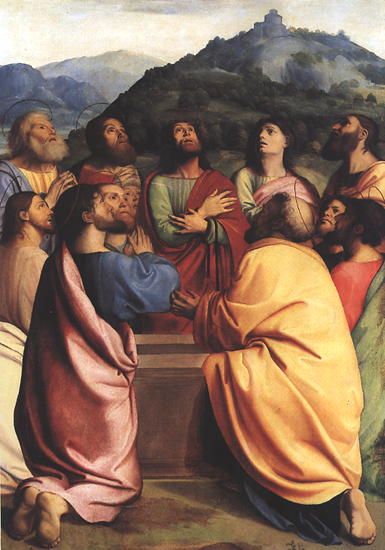
Alberto_Piazza_Apostoles_entorno_al_Sepulcro_Staatliche_Museen_Berlín

Apóstoles entorno al Sepulcro (“Apostles around the Grave”), by Albertino Piazza da Lodi [c.1520]

From the deeps I call out to you, O Lord; my Lord, hear my voice!
Let your ears be attentive to the sound of my pleadings. …
I await the Lord!
My spirit looks––and for His message I am waiting––
my spirit looks for my Lord
more than the watchmen for the morning, the watchmen for the morning.
            –from Psalm 130

Today is the Great Vigil, the feast which marks the end of the Lenten season.  For the last forty days, we have prayed and fasted to one degree or another.  We have acknowledged our own sin and mortality, remembered our need for forgiveness and redemption, and awaited the advent of our Messiah on His royal steed to save us from our distress.  Over the past week, the week of His holy Passion, we have grieved as the cheers of adulation turned to jeers of mockery.  We have stood by as a best friend betrayed Him with a gesture of feigned affection.  We have both pounded the nails into His hands and kissed His feet as He hung on the cross.  All this we have done, and tomorrow we will celebrate.  But today…

Today is Holy Saturday, the Great In-Between Day, the cosmic sabbath rest of Jesus Christ entombed in stone.  A friend of mine once whimsically reflected on this particular Saturday, saying that it always feels like “the deep breath before the plunge.”  The sentiment is fitting; today, the clockwork of the entire universe is held in suspended animation.  The Three Days (called “triduum” in the church-Latin) are days of activity: on Maundy Thursday, Jesus washes our feet, showing us the way of the cross and teaching us His new command to love and serve and sacrifice for His sake. Yesterday, on Good Friday, Jesus suffers the pain of our atonement, breaking His own body and pouring out His own blood, even unto death. Tomorrow, on Easter Sunday, Jesus rises from the dead and ascends to God in triumph.  Yesterday we despaired, and tomorrow we will exult.  But today…today is, well, in-between.

Today is also the seventh day, the day of rest.  It is a day of nothingness, of darkness and chaos, of anticipating the creative and re-creative work of God.  Tomorrow is a day full of life and light, when the Sun rises and fills all the earth with the knowledge and glory of God.  The ground will sprout forth its vegetation, the trees stretching out their hands in praise.  The sea, the air, the land, all teeming with swarming creatures, will revel in the beauty and grandeur of what God has done for us and with us.  And God will say that it is Very Good.  Tomorrow, God will speak out into our darkness, “Let there be light!”  But all of that is still Tomorrow.  For as long as it is called “Today,” it is not Day; it is Night.

Today, the deep covers the earth, and darkness is over the face of the waters.  Yet the Spirit of God hovers in the air, looking, yearning, groaning for the redemption of our bodies, of His body.  Can you see?  The days of creation and redemption and re-creation are all ordered alike: darkness, then light; evening, then morning; death, then life; for first comes the night, and afterward the dawn.

But the Resurrection is not yet come.  So we wait, our spirits looking for our Lord, more than the watchmen for the morning…

…the watchmen for the morning…


A Triptych of Light for the Triduum: Good Friday

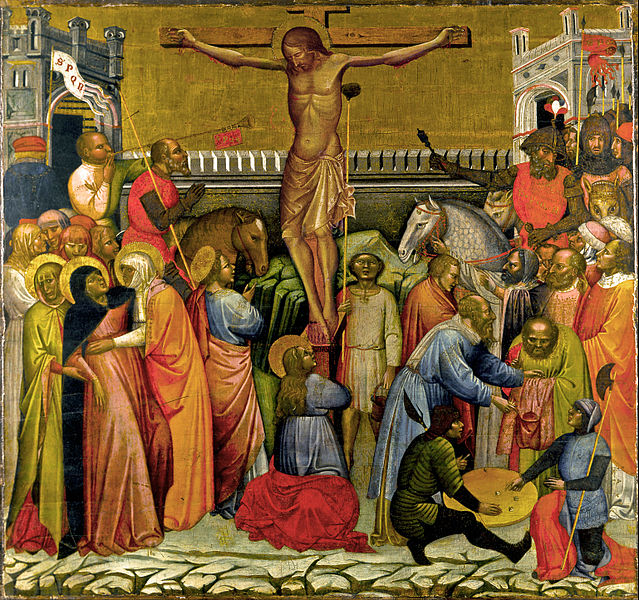
Jacobello_del_Fiore_Crucifixion

Crucifixion, by Jacobello del Fiore  [c.1400]

Be gracious to me, O Lord, for I am distressed;
my eye wastes away in grief, my spirit and my body.
My life is spent from sorrow, and my years from groaning;
my strength fails in my iniquity, and my bones are wasted away.
I have become a reproach to all my enemies––and to my neighbors especially––
and a dread to my acquaintances; those who see me in the street flee from me.
I am forgotten, like a dead man, out of mind;
I have become like an earthen vessel, destroyed.
For I hear the whispering of many, terror from all around in their scheming together against me;
they plot to take my life.
But me––on you I am trusting, O Lord; I am saying, “You are my God.”
The seasons of my life are in your hand;
rescue me from the hand of my enemies and my persecutors.
Shine your face on your servant!  Save me in your lovingkindness.
             –from Psalm 31

Yesterday’s meditation was quite cerebral; in contrast, this passage is exactly the opposite.  This psalm is sentimental, even visceral in its portrayal of emotions that we have all experienced.  But for today, let us not personalize this prayer with ourselves as the target.  It is tradition in the Christian religion to re-enact in our worship during Holy Week the events of Christ’s Passion––we wave palm fronds, wash each other’s feet, venerate Jesus on the cross, and hold vigil until his resurrection.  Today, I encourage us to take the imagination one step further, to transport ourselves back in time and participate in the events themselves.  We are the same crowd that chants both “Hosanna!” and “Crucify!”  So let us forget our lazy and fickle selves and rather seek to identify with Christ.

Let us plead with the Father to be gracious to Jesus as his spirit and body expire upon the cross.  Let us groan with sorrow at the reproach that Jesus endured from his enemies, and especially from his closest friends.  Let us lament that in his death Jesus has been forgotten, out of mind, by the very people he came to save––in spite of the fact he is indeed risen from the dead!  Let us hear the plotting and the scheming against his very life; and let us not raise our voices in protest but instead say…

Not my will, Father; but Your kingdom come, Your will be done.

Jesus trusted God his Father.  Let us also trust.  Jesus prayed, “You are my God.”  Let us also pray.  Jesus placed his life in the hand of his Father, truly and literally, even in the midst of a rejection and forsaken-ness that he had never known before.  The most intimate and everlasting fellowship of the Triune God was broken somehow during those few hours while Jesus hung on the cross.  Is it really so much for us to trust Him in the midst of our loneliness and pain?  Yes, it is so much: too much, in fact.  It was not too much for Jesus, but it is too much for us.  However, God’s grace is sufficient even for that.  In the end, all we can say is this:

Father, we beg You, please smile on us and save us in Your lovingkindness! 

So let us say it, together, today.  Then let us empathize with Jesus our Mediator, the one close to the Father’s heart, His one-and-only well-beloved Son, in whom He is well pleased.

A Triptych of Light for the Triduum: Maundy Thursday

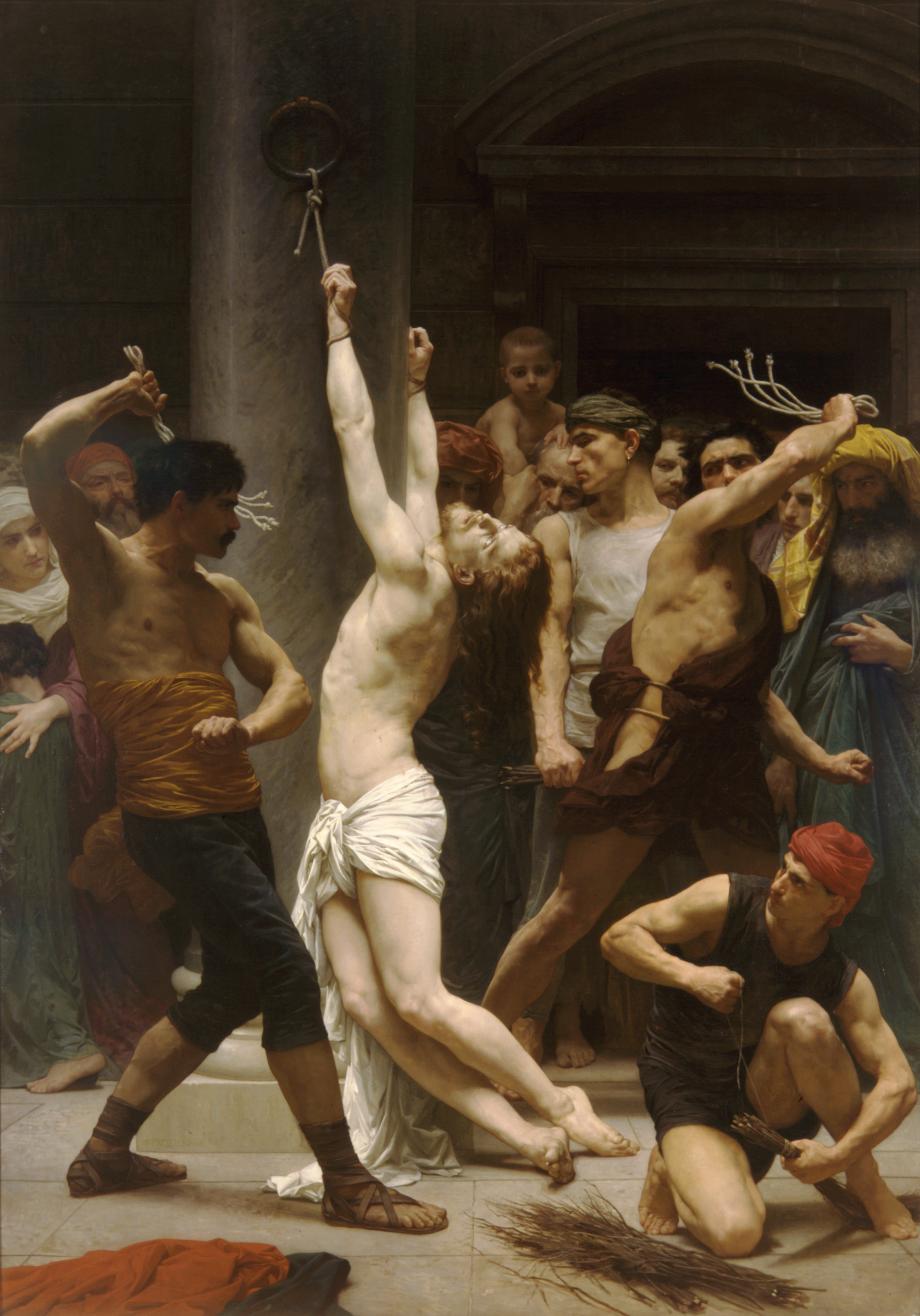
William-Adolphe_Bouguereau_(1825-1905)_-_The_Flagellation_of_Our_Lord_Jesus_Christ_(1880)

The Flagellation of our Lord Jesus Christ, by William Adolphe Bouguereau [c.1890]

But he was pierced for our transgressions, crushed for our iniquities;
the punishment that gave us peace was on him, and by his wounds we are healed.
He was oppressed, and he was humiliated, but he did not open His mouth;
for he was cut off from the land of the living, stricken for the transgression of my people.
They placed his grave with the wicked, and with the rich in his death;
because he had done no violence, with no deceit in his mouth.
Out of his anguish he shall see light; he shall find satisfaction through his knowledge.
The Righteous One, my servant, shall justify many; and their iniquities he himself shall bear.
            –an excerpt from Isaiah 53 (emphasis added)

These words are worth contemplating as we memorialize once again the holy Passion of Jesus.  This is the very passage which the Holy Spirit used––via a series of extraordinary events that you can read about in the book of Acts, chapter 8––to introduce the Gospel to the continent of Africa several chapters ahead of the missionary endeavor to Europe (which does not commence until Acts 16).  On the return journey from Jerusalem to his own country, a man whom we know simply as the “Ethiopian eunuch” was reading this text and was confounded by the question, “Is the prophet here speaking of himself or someone else?”  Philip the Evangelist answered him by affirming that this passage speaks about Jesus the Messiah, the Suffering Servant of the book of Isaiah. One of the ways we know that this text is about Jesus is because of the word “light” which I have highlighted in the translation above.

In modern English, we use the expression “see the light” to communicate figuratively the idea of recognizing or realizing the truth.  But in ancient Israel, the expression “to see light” was used in a literal way to communicate the idea of being alive as opposed to either unborn or dead (see Job 3:16; Psa 36:10, 49:20).  In the book of Isaiah, the prophet takes great pains to communicate to the reader that the Suffering Servant will suffer, die, and be buried (v.10), but then afterward will be alive again and “see light.”  In other words, the prophet foretells the story of the resurrection of Messiah, not with a grand flourish but with a common figure of speech.  That is God’s way, is it not?  We might have missed it had not Jesus pointed out to his disciples (and the Holy Spirit to us) that the Hebrew Scriptures prophesied that the Messiah would both die and rise again.

Then Jesus opened their minds to understand the Scriptures; and he said to them, “Thus was it written for Christ to suffer and to rise again from the dead on the third day, and repentance for the forgiveness of sin to be proclaimed to all nations, beginning from Jerusalem.  You are witnesses to these things”  (Luke 24:45-48, emphasis added).

Yes, Jesus, we are witnesses.  Thanks be to God.

Jesus Christ: God from God, Light from Light, True God from True God; the Light of the World, prepared for all the world to see, for the enlightening of nations; He who descends into the earth like the sun and ascends into heaven with the dawning of a new day, a new age, a new covenant of peace between God and humankind.  By His light we see light.  By His wounds we are healed.  He who knew no sin was made sin for us, so that we might be made the righteousness of God in Him.  We eat His flesh, broken for us; and we drink His blood, the cup of our salvation.

For we proclaim the Lord’s death until He comes.

Meditation for the Feast of St Patrick

patrick

Icon of Saint Patrick, Enlightener of Ireland

“The Lord is my light and my salvation; whom shall I fear?
The Lord is the strength of my life; whom shall I dread?
One thing I have asked from the Lord, that will I seek:
to remain in the house of the Lord all the days of my life;
to stare at the beauty of the Lord, and to pray in his temple.
So I will offer in his tent sacrifices of joy;
I will sing and make praise-music to the Lord.”
– an excerpt from Psalm 27

The Lord is my light, writes the psalmist.  The phenomenon of light is one of the most primitive of all human experiences, yet we rarely give it a second thought except for when we need it.  The sun is one of the most dazzling of earthly wonders, yet it blinds us when we stare at it.  If in the modern age we were to take away the comfort of electrical technology, we would not be left with many other sources of light other than the sun.  Starlight doesn’t illuminate very much, and lightning only shines for a split second at a time.  Firelight is a little better, but still not very useful for the actual work of living.  Can you imagine trying to plow a field with a team of oxen by torchlight?

When considered from this perspective, one can understand why sun-worship was such a common practice in ancient cultures and yet a relatively rare practice today.  [Of course, we worship other idols––self, money, family, and the list goes on.]  It is truly remarkable that in ancient Israelite culture there existed a group of people who did not worship the sun but claimed instead that God was their “light.”  They claimed that this Divine Being, who created both the sun and the light, could not be seen or touched but that his Voice could be heard in some mystical way.  So let me ask you, who would worship a god like that when the sun makes itself available and perceptible each and every day, without fail?

Who could?  Surely, not us, blind sinners that we are.

Patrick of Ireland, whose feast we celebrate today, wrote strong words for those who worshiped the sun (see below).  Consider his reasoned argument: the sun is temporal and has no power; Christ, on the other hand, has ruled with the Father and the Holy Spirit for all eternity; therefore, worship Jesus.  He affirms that it is Jesus––not some delicate balance between the properties of physics that we call gravity and inertia––who commands the sun to rise each and every day.  But this is not a theological innovation on the part of bishop Patrick; no, he simply repeats what the Israelite prophets said of old (Gen 8:20-22; Job 9:7; Isa 45:7; Jer 31:35-37; Amos 5:8-9).  The psalmist goes a step further, however, declaring his desire to worship God not because it is rational––although it is that, since God has saved him, after all––but because it is pleasurable to “stare at the beauty of the Lord.”

Jesus takes this theological metaphor of light to its final conclusion when twice he says, “I am the light of the world” (John 8:12, 9:5).  In English, it’s a ready pun: not the sun, but the Son.  However, the truth of the matter is so much more devastating, for Christ is the “light” NOT because we are blinded when we look at Him, but because we are blind until we look at Him.  Jesus himself uses this exact conceptual wordplay: “For judgment I have come into this world; so that those who do not see might see, and the ones who see might become blind” (John 9:39).

Therefore, seeing the truth of these things, today let us offer a sacrifice of joy alongside Patrick our brother, and (literally!) sing and make praise-music to the Lord.  For He Himself is our Light and our Salvation.

     “For this sun which we now see rises each new day for us at his command, yet it will never reign, nor will its splendor last forever.  On the contrary, all who worship it today will be doomed to dreadful punishment.  But we who believe and adore the true sun that is Christ, who will never die, nor “will those who have done his will” but “abide forever, just as Christ himself will abide for all eternity”: who reigns with God the Father all-powerful, and with the Holy Spirit before time began, and now and through all ages of ages.  Amen.”
          –an excerpt from The Confession of Saint Patrick, translated by John Skinner (New York: Doubleday, 1998), p.75.