“…between Migdol and the Sea…”

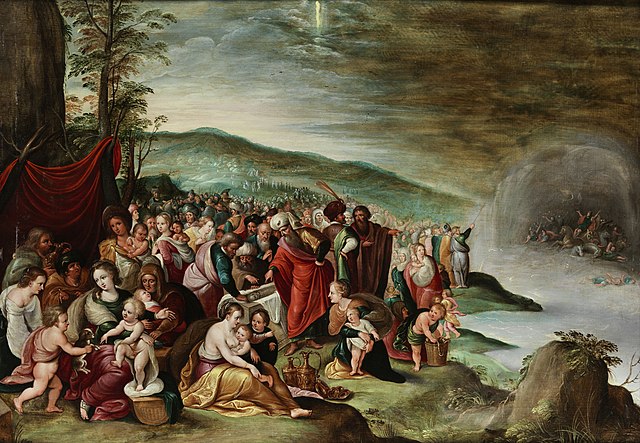
Vincent Malo, “Moses Parting the Red Sea” (1631)

When Pharaoh let the people go, God did not lead them on the road through the Philistine country, though that was shorter…God led the people around by the desert road toward the Red Sea…By day the LORD went ahead of them in a pillar of cloud to guide them on their way and by night in a pillar of fire to give them light, so that they could travel by day or night. Neither the pillar of cloud by day nor the pillar of fire by night left its place in front of the people.

Then the LORD said to Moses, “Tell the Israelites to turn back and encamp near Pi Hahiroth, between Migdol and the sea. They are to camp by the sea, directly opposite Baal Zephon. Pharaoh will think, ‘The Israelites are wandering around the land in confusion, hemmed in by the desert.'”…So the Israelites did this.

When the king of Egypt was told that the people had fled, Pharaoh and his officials changed their minds about them…So he had his chariot made ready and took his army with him…The LORD hardened the heart of Pharaoh king of Egypt, so that he pursued the Israelites–all Pharaoh’s horses and chariots, horsemen and troops–pursued the Israelites and overtook them as they camped by the sea near Pi Hahiroth, opposite Baal Zephon.

Exodus 13:17-14:9

This story is so compelling to me. In case you don’t immediately know the context, this is the set-up for the Red Sea crossing in the book of Exodus. What’s so compelling to me about this story is how God orchestrates every single detail of it. And it makes absolutely no sense. [Well, unless God intends to do something so incredibly mind-blowing you never would believe it.].

If we were to speak in simple militaristic terms, God leads the Israelites into a trap. Then God Himself springs the trap that, apparently, He Himself has set. Do you see that? The Israelites are on their way out of Egypt, and then God tells them to … wait for it … Turn. Around. Then God tells them to go to a very specific place, “between Migdol and the sea.” We don’t know exactly what this place “Migdol” refers to, but in Hebrew the word means “tower” (presumably a fortified place). This specific place is near Pi Hahiroth and opposite Baal Zephon––again, two places where we don’t know the precise locations. But God wants them to camp by the sea. And apparently, there’s only one way out of this place, which is back the way they came.

At this point, the author says that God hardened the heart of Pharaoh so that he and his army would chase the Israelites. God explicitly says what Pharaoh and his officials will think. The Egyptians observe that the Israelites have gone to a place that they can’t get out of, because they are “hemmed in by the desert.” So the Israelites are encamped by the sea with the desert all around, and then they see the Egyptians blocking the only route of escape.

Every single one of these happenings and events are directly orchestrated by God. The author is very careful to tell us this. The Israelites have been following God, exactly like they’re supposed to do. And they are trapped. Trapped “between Migdol and the sea.” The story continues…

As Pharaoh approached, the Israelites looked up, and there were the Egyptians marching after them. They were terrified and cried out to the LORD.

Exodus 14:10

[Of course, you know how the story progresses. The Israelites complain to Moses. Moses cries out to God. God tells Moses to lift up his rod and tells the people to go forward, then God divides the waters and the Israelites cross the sea on dry land. The Egyptian army pursues them into the sea and are swallowed by the abyss when the waters return to their normal state.]

But I’ve stopped the story at this exact point for a reason. The Israelites are terrified, understandably so. The Israelites cry out to God, and so they should. God is the one who got them into this mess in the first place! [Except it’s not a mess. It simply appears that way in the moment. But I’m getting ahead of myself again!] What I want to point out here at this precise moment in the story is how terrifying this mode of travel is. The Israelites are, literally, “following God.” Into the desert. Into the unknown. Into certain death, for they know that they will all die eventually. Pause a moment.

Now fast forward…across the Red Sea to the foot of Mt Sinai, where the Israelites camped for over a year before they continue their journey home…

This is how it continued to be…Whenever the cloud lifted from above the Tent, the Israelites set out; wherever the cloud settled, the Israelites encamped. As long as the cloud stayed over the tabernacle, they remained in camp. When the cloud remained over the tabernacle a long time, the Israelites obeyed the LORD’s order and did not set out. Sometimes the cloud was over the tabernacle only a few days; at the LORD’s command they would encamp, and then at his command they would set out. Sometimes the cloud stayed only from evening till morning, and when it lifted in the morning, they set out. Whether by day or by night, whenever the cloud lifted, they set out. Whether the cloud stayed over the tabernacle for two days or a month or a year, they Israelites would remain in camp and not set out; but when it lifted, they would set out. At the LORD’s command they encamped, and at the LORD’s command they set out.

Numbers 9:16-23

This paragraph clearly communicates that this literal practice of “following God” was the normative mode of travel for the Israelites from the time they left Egypt until the time they entered their ancestral homeland about 40 years later. When God took a step, the Israelites took a step. When God stopped, the Israelites stopped. When God turned right, the Israelites turned right. When God turned left, the Israelites turned left. When God went up over the mountains, the Israelites went up over the mountains. When God famously went through the Rea Sea, the Israelites also went through the Red Sea.

As Christians, we often conceptualize the spiritual life as a journey of inner transformation, and that is wholly appropriate. Most of the New Testament is concerned with this very thing…how the people of God should be inwardly formed more into the likeness of Jesus. Over time, we should grow in love, joy, peace, patience, kindness, gentleness, goodness, faith, meekness, self-control, etc. But if we see this journey of the Israelites through the desert as somehow instructive for our spiritual life as Christians, then there is more to it than simply an internal journey. We can see some external evidence of inner change taking place among the Israelites as they travel through the desert. But the journey through the desert is equally external as well as internal, as demonstrated by this mode of travel. We can say in a very literal sense that the Israelites “walked about with God,” which is the phrase the author of Genesis uses to describe both Enoch (Gen 5:22) and Noah (Gen 6:9). God determined the actual path they traveled through the desert.

Now let’s fast forward again…this time all the way through the incarnation, resurrection, and ascension of Jesus to St Paul the apostle writing his letter to the Romans…

Therefore, there is now no condemnation for those who are in Christ Jesus, because through Christ Jesus the law of the Spirit of life set me free from the law of sin and death…[God’s Son] condemned sin in sinful man, in order that the righteous requirements of the law might be fully met in us, who do not live according to the sinful nature but according to the Spirit…Those who live in accordance with the Spirit have their minds set on what the Spirit desires. The mind of sinful man is death, but the mind controlled by the Spirit of life is life and peace…You, however, are controlled not by the sinful nature but by the Spirit, if the Spirit of God lives in you…Therefore, we have an obligation––but it is not to the sinful nature, to live according to it. For if you live according to the sinful nature, you will die; but if by the Spirit you put to death the misdeeds of the body, you will live, because those who are led by the Spirit of God are sons of God.

Romans 8:1-14 (emphasis added)

The Israelites were led by the Spirit of God. They thought they were going to die. But they lived.

The Christian spiritual life means to keep in step with God’s Holy Spirit. When He steps, we step. When He turns right, we turn right. When He turns left, we turn left. When He stops, we stop. St Paul is primarily talking about internal transformation here, but he uses a metaphor grounded in the Israelite story of the Old Testament. To walk in accordance with the Holy Spirit means to be led by Him, even controlled by Him. It’s not only internal transformation; it’s external direction as well.

Here’s the moral of the story. If you ever find yourself “between Migdol and the sea,” and you feel terrified because the Egyptians are bearing down upon you, cry out to God. Perhaps, like the Israelites, He Himself led you there. It’s not a mistake. Trust God.

Or, perhaps more likely, you fear to “walk about with God” because God might lead you into that very place––”between Migdol and the sea.” If that is you, cry out to God. Take courage. Follow God, and you will live.

Is there a “Divine Council” in Genesis 1?

Q: I recently heard a teaching about Genesis 1:26 that I’m confused about.  The verse says, “Let us make man in our image, after our likeness.” I was always under the impression that this pointed to the Trinity, although it’s not explicitly stated. However, this pastor was saying it’s NOT the Trinity but rather that it’s referring to “God and his divine council made up of sons of God, created in the image of God and share in the reign of the spiritual world with God” (direct quote from his sermon).  I had never heard this before and feel like this is a poor exegesis of the text. I did a little research, and I think he pulled it from Michael Heiser’s work (possibly his book The Unseen Realm).  I feel like it’s a little controversial. This pastor’s teaching is bothering me, but I don’t have much knowledge to really back up why I feel that way!

When you come across something that sounds skeptical, what you should do to look and look and look at the text, and then look at the text some more, to see if what is being said actually does match up with it.  It’s the looking at the text part that many people don’t do, when it comes right down to it.  And it is the same with this particular textual problem.

It is very common among Christians to understand the plural pronouns used in God’s speech in Genesis 1 as evidence for the Trinity.  And indeed, as a Christian that is how I understand them.  At the same time, however, I absolutely must affirm that I read the text this way because I am importing Trinitarian theology (post-Incarnation of Jesus) back into that pre-Incarnation text.  There is nothing in Genesis 1 itself that would lead us to read that speech of God as some sort of Trinitarian conversation.

However, the “Divine Council” view of that speech is also not substantiated anywhere in the Genesis 1 text.  That view, whether it comes from Michael Heiser or others, is a projection onto the text of other information about the ancient Israelite conceptualization of the heavenly realm (either from other parts of the Bible or from other extra-biblical sources).  This means that the Divine Council view is just as problematic as the Trinitarian view in terms of the exegesis of the actual text itself.  

When we read Genesis 1 and come across the plural pronouns used by God in his speech, we should look at the local text for clues regarding how to understand that peculiar aspect of the text.  In the case of Genesis 1, there are two clues which can help us.  First of all, the word for God is plural instead of singular.  Now just because a word is plural does not mean that the referent is plural.  A plural form in Hebrew can refer to something singular, similar to how “pants” in English refers a singular article of clothing even though the word itself uses a plural form.  So it is possible to read the Hebrew plural form for God as somehow referring to some kind of multiplicity in God, but it is not assured simply from the form itself.  Secondly, there is a reference to a “spirit of God” in Genesis 1:2.  Of course, this brings up the question: “How does the ’spirit of God’ relate to ‘God’ within the conceptual world of the author writing the story?”  And we don’t know the answer to that question.  I’m only saying that, if we read the text itself and look for the contextual clues in the local context, the plural pronouns in reference to God would appear to refer to some kind of relationship between “spirit of God” and “God.”  

Of course, Christian Trinitarian theology quickly speaks up and suggests an answer.  And rightly so, if we believe the manifold witness of Christian interpreters throughout the centuries.  However, as I said earlier, we must affirm that that view does not truly arise from the text itself but is rather a later explanation of the text provided after Jesus came to earth as revealed to us that God is Trinity and not simply unity.

If we want to speak strictly about the point of view of the Genesis author, we must confess that we don’t know what the author had in mind when God speaks using plural pronouns.  It is a mystery of the text. In theory, the “Divine Council” might be correct…but it could just as easily be incorrect.  It’s really just speculation.  And most of the time, as an exegete and theologian I usually prefer to stop at the place of mystery rather than speculate on solutions that could just as easily be wrong as right.  Generally speaking, I think it’s a wiser way to handle the Scriptures.

Obedience, not sacrifice

Q: I’ve been reading 1 Samuel and got to the part in chapter 15 where Saul is disobeying God. Samuel says to him that submission and obedience is better than sacrifice.  I’m confused, because I feel like sacrifice IS obedience and submission. I never considered the hierarchy or that God prefers one over the other. What then would you say is the difference? What is it about obedience and submission that God desires more than sacrifice? Is it a heart condition? What is God truly after? 

1 Samuel 15 is a really interesting chapter, for many reasons.  God had unequivocally told Saul what to do, via Samuel the prophet.  God’s instructions were to kill the Amalekites along with all their belongings and possessions.  Saul did not obey.  Instead, he preserved the best sheep of the livestock and then reported to Samuel that the purpose was for sacrificing to God.  Maybe Saul was lying about that.  Maybe Saul was telling the truth.  We don’t know.   Samuel’s point in reply is that God does not take pleasure in the killing of animals for the sake of killing animals.  God takes delight in us heeding His voice.  Saul had his priorities mixed up.  In the end, he didn’t care very much about doing what God asked him to do.  And that’s why God rejected him as king.  Saul rejected the “word of Yahweh.”  Therefore, Yahweh rejected him from being king.

I wonder if the actual words “sacrifice” and “obedience” themselves are confusing the issue here.  Maybe think about the word “ritual” instead of the word “sacrifice.”  In reality, that’s what the sacrificial system was for the Israelites.  It was a series of elaborate religious rituals that reminded the people that the animals they were sacrificing were taking their place in receiving the judgment of Yahweh on account of sin…for one more day, one more week, one more month, one more year, etc., until Messiah could come and take the judgment permanently.  If you replaced the word “sacrifice” with “ritual”, would you still be as inclined to say that “ritual IS obedience and submission.”  

Think of your own religious rituals.  We all have them.  The Eucharist, for example.  If you took the Eucharist (or perhaps you call it “communion”) faithfully, every day, but then murdered someone once a week, what would be the moral value of your religious ritual?  Jesus commands us to celebrate the Eucharist.  You’re “obeying”, but only in a manner of speaking.  By murdering, you would be disobeying on a much grander scale, so much so that it would make your celebration of the Eucharist next to meaningless, if not wholly meaningless.  Granted, it’s an extreme analogy, but I did that on purpose to make the point.

In short, God desires that we do His will in the world.  God does not desire that we kill animals just for the sake of killing animals, or ingest some bread and wine just for the sake of ingesting bread and wine.

Help! I need answers…

Q: When I have questions about the Bible, how do I look for the answer in Scripture? I know Google is not a trusted resource. For example, last night I was thinking more on Genesis, and God created the heavens and earth. But did he create them at the same time? If Jesus was always with God, wouldn’t that mean there was a heaven before this? Or some other realm? These are things I would like to dive into when I have free time, and the process in which to do so seems unclear. How would you suggest I find answers in the Bible to questions like these, if they are available?

I hear and understand your primary question here.  “How do I look for answers in Scripture?”  This is an important question.  First, I think this is why regular Bible reading is so important, and especially reading large portions.  For example, if you read the Bible through every year and do so repeatedly for years on end, you would start to notice connections that you didn’t notice before simply as a function of becoming increasingly more acquainted with all the text that is actually there.  It’s why I have titled this blog, Reading the Old Testament.  In the end, the absolute best thing we can do to study the Bible is simply to READ it…and read it over and over and over and over and over and…you get the idea.

Secondly, I recommend finding a good book on biblical hermeneutics and working through it.  I think you would find that really helpful.  In my opinion, the very best book out there on this topic is Methodical Bible Study by Robert Traina.  It’s out of print now, so you have to find used copies, but it’s not difficult to find.  Like I said, I think it’s the best book out there on how to study the Bible.  However, it’s a seminary textbook, so it’s not an easy read.  If that seems a bit too daunting, then I would recommend Living By the Book by Howard Hendricks.  A third, middle-of-the-road option would be Introduction to Biblical Interpretation by William Klein, Craig Blomberg, and Robert Hubbard.  The only drawback to that book is that it is very long, but it’s not too difficult, and it’s good.  But the very purpose of these books is to help answer the very question you are asking — “How should I be looking for answers in the Bible to my questions?”    

But if you have an inquisitive mind and you feel like you have questions about the Bible, then by all means you should look for answers both in the Bible and outside the Bible!  God gave us minds for a reason.  And yes, we should always pray and ask God for wisdom.  [After all, God promises to give us wisdom when we ask for it honestly.] At the same time, we read the Bible in community, since all of us as Christians are indwelt by the same Holy Spirit.  So it is good and right and proper for us to teach and listen to each other when we are asking and answering questions.  So by all means, research biblical topics that you’re interested in!  

Prov 25:2 says, “The concealing of a matter is the glory of God; but searching out a matter is the glory of kings.”  I take this verse to mean that God has “hidden” all kinds of things in the world for us to search out and discover, and God is glorified when we do.  Including in the Bible!  Truth always stands up to inquiry.   So by all means, ask away!  God is not obligated to answer all our questions, but I think He delights in our asking them, when we do so honestly and with a desire for His glory.

If you’re looking for a good commentary series, I recommend the New International Commentary series.  However, in my opinion the very best theological commentary on the Old Testament is the book of Hebrews in the New Testament (followed by the whole of the New Testament itself).  Commentaries are great and all, but the very best way to try to understand theological problems in the Old Testament is to keep reading the Bible, over and over again.  Keep the main thing the main thing!

“…in the Garden of the Lord”

Do you hear the people sing
Lost in the valley of the night?
It is the music of a people
Who are climbing to the light.

For the wretched of the earth
There is a flame that never dies;
Even the darkest night will end,
And the sun will rise.

They will live again in freedom
In the garden of the Lord.
They will walk behind the plough-share,
They will put away the sword.
The chain will be broken
And all men will have their reward.

Will you join in our crusade?
Who will be strong and stand with me?
Somewhere beyond the barricade
Is there a world you long to see?

Do you hear the people sing?
Say, do you hear the distant drums?
It is the future that they bring
When tomorrow comes!

So goes the final chorus of the musical, Les Miserables.  As a Hebrew scholar, what’s remarkable to me about this piece of exquisite poetry is that nearly all the imagery is taken directly from ancient Hebrew writings in the Tanakh (i.e. the Old Testament of the Bible).  I would like to expound on this imagery as it is used in the song, which mirrors the usage of the imagery in the ancient documents.

First, let’s identify the images in the song that are NOT taken from the Hebrew writings: of singing and music; of the valley and climbing; of the barricade and its rhyming term, crusade; of the broken chain; and finally, of distant drums.  The concepts of music and singing are to be expected, since the poem itself is a song set in a musical drama.  The image of the barricade comes from the immediate context, a musical depicting the events of the June Rebellion in Paris during the summer of 1832.  None of these images provide the primary meaning of the lyrics, however.  Rather, particularly in the case of the barricade and distant drums, these images are endued with their meaning in this particular context by the other images in the song, taken from the Hebrew writings.

The most easily recognized images appear in the middle section, the single stanza of the poem that contains six lines instead of the usual four.  Let us examine the first line, “They will live again in freedom in the garden of the Lord.”  In this line, the author introduces the source text for the poem’s imagery as well as the central theme that the poem expounds.  The specific phrase that sets the source text for the poem is, “the garden of the Lord.”  This is fairly recognizable as a reference to the biblical story of the garden of Eden, sometimes also called the “garden of God” in the Hebrew writings.  In case there is any doubt of this, the term “the Lord” proves the case.  Since ancient times, the Hebrews would not voice the name of their deity, Yahweh, because of religious traditions rooted in the Ten Commandments.  They would instead say, “the Lord,” just as it is rendered in our English Bible nowadays (usually in all caps, the “LORD”).   So we have established that the author is drawing from the imagery of the ancient Hebrew writings, as we will continue to see.

Let us now examine the phrase, “They will live again in freedom….”  The key word here is again.  The song is making a statement about a future life; not the present life, but a life after death.  It turns out, this small detail makes all the difference in the song.  What gives the poetry its power is not a pie-in-the-sky type of unfounded sentimentalism that somehow the poor and wretched of the earth will lift themselves from their squalor and everything will be right as rain.  Our collective human experience proves the falsehood of these dreams, honorable though they are.  No, the poem declares that the freedom of the oppressed peoples of the world lies not in this life, but in the next.  Ironically, though, this declaration is paired with a call to action of behalf of poor and wretched souls on earth now.  But I’m getting ahead of myself.

Where will these poor and wretched people live in freedom?  In the garden of the Lord, i.e. in paradise, with God.  [I won’t relate all the details of the story of the Garden of Eden because it’s so familiar, but the main point is that humankind is banished from paradise on account of sin, because they have disobeyed God.] This sense of freedom is described throughout the prophetic Hebrew literature in terms of peace; and in a few select locations, using the contrasting ideas of a sword to represent violence and war and a plough-share to represent peace and work (specifically the work of tilling ground).  This image is also familiar, since it comes from the patron text of the United Nations: “They will beat their swords into plough-shares and their spears into pruning hooks.  Nation will not take up sword against nation, nor will they train for war any more” (Isaiah 2:4b).  This is quoted again by the prophet Micah (Micah 4:3), and a strange inversion of it by the prophet Joel in calling the nations to prepare for war as a divine judgment on Israel (Joel 3:10).  The main point here is that the elysian vision of the Hebrew writers was a return to life in the Garden of Eden — a life of peace with God, peace with humanity, peace with the cosmos.

When does this paradisical life occur?  The song avers this will happen when the “chain is broken” and “all men have their reward.”  At this point, we still do not know what is meant by the chain, so we will pass over it for now.  However, given the biblical imagery already offered in the stanza, we can understand the thought that all men will have their reward.  In the Hebrew vision, the life of peace and justice is brought about because God Himself, as divine judge, will mete out to all people what they deserve.  If we look in the Isaiah text to the line immediately preceding the bit about swords and plough-shares, we read, “[The LORD] will judge between the nations and will settle disputes for many peoples” (Isaiah 2:4a).  Again, this is an undeniable theme throughout all of the literature of the Hebrew Bible.  The Hebrew sages continually urge their readers not to fall into wickedness because “the day of the LORD” is coming when He will judge everything and everyone.  Take note of this metaphor … the day of the Lord.  

So we have now set forth the fundamental ideas of the poem, centered around the middle stanza: that the hope of the poor rests not in the present time, but in the afterlife, living in paradise in the presence of God, following the just judgment of God in dispensing justice both on the oppressor and for the oppressed of the world.  The person and action of God cannot be divorced from this vision, for it is He who actuates it.  But the song goes one step further here to suggest that God will not simply judge on behalf of the oppressed in paradise, but that God is doing so even now, in the present life.  This we will see presently.

We now come to the first image in the previous stanza, i.e. the everlasting fire.  “For the wretched of the earth there is a flame that never dies; ….”  The question is, of course, “What is the ‘flame that never dies?'”  Once again, the answer comes from the Hebrew writings.  The specific reference to a fire that never goes out is found in Exodus 3, in the lesser-known story of Moses and the burning bush.  “The angel of the LORD appeared to [Moses] in flames of fire within a bush.  Moses saw that though the bush was on fire it did not burn up.”  In case there is any doubt about who is here in the fire, the text identifies Him two sentences later: “…God called to him from within the bush, ‘Moses! Moses!'”  God Himself is the everlasting fire.  The poem is saying that God is the present hope of the oppressed, but that this present hope is grounded in the reality of future judgment, when the night is over and the sun rises.

Let us now consider the nature of this night and the coming dawn.  In the imagery taken from the Hebrew writings thus far, it seems clear enough that the terms night and light are metaphors for death and resurrection.  Not only this, but even the Hebrew text itself uses the same metaphors in the same way!  I have already mentioned that the Hebrew writers referred to the coming judgment of God as the day of the LORD.  In the Hebrew worldview, a day started with the evening; thus the movement of a day in the Hebrew mind was from darkness to light, from dusk to dawn, from night to day.  This same mindset extended to their vision of the afterlife as well.  To the ancient Hebrew, death was not permanent but temporary, like sleep.  In fact, one of the clearest texts showing the Israelite view of the afterlife affirms this very thing.  “There will be a time of distress such as has not happened from the beginning of nations until then.  …  Multitudes who sleep in the dust of the earth will awake: some to everlasting life, others to shame and everlasting contempt.  Those who are wise will shine like the brightness of the heavens, and those who lead many to righteousness, like the stars for ever and ever” (Daniel 12:1-3).  Death is the sleep of night, followed by the awakening of resurrection, at which time the judgment will occur and the afterlife (or after-death, for some) will commence.  This use of night/darkness contrasted with the coming day/light as metaphors for death and resurrection is central throughout each stanza of the poem and finds its climax in the final line, “…when tomorrow comes!”  Death is the night, the chain, the barricade, the distant drums.  In the future, at dawn, comes judgment, and after that, the world beyond the barricade … paradise.

All this brings us to the central theme of the poem, the fundamental question that the author asks the listener.  Do you see the world beyond the barricade, or have you shut your eyes?  When the people sing, they are singing of their lostness in the night and their hope for a new day.  Do you hear them sing, or are your ears stopped up?  And most directly, will you join in God’s crusade on behalf of justice for the poor and oppressed, not only for tomorrow, but for today?  Or will you, like the general populace of Paris, do nothing?  The drums are beating.  Judgment is coming.  And when it comes, will you stand or fall?

This is the message of the song.   But if you will indulge me for just a moment longer, I want to press the issue a little further — further than is explicitly expressed in the poem, because the central question of the song begs a deeper question still.  Finally, what actually makes the difference between those who pass the judgment, and those who fail?  I believe the song hints at the answer, but we must look back to the Hebrew writings to see it fully.  In the Garden of Eden story, death is the penalty for sin, and eternal life is only gained by eating the fruit of a certain tree, the Tree of Life.  However, God evicted humankind from paradise and placed the cherubim at the entrance to the Garden of Eden.  Now often, the images conjured up in our minds are one or two large flaming angels, wielding longswords and looking fierce, ready to cut down anyone who attempts to re-enter paradise.  But I do not believe this is the proper conception from the Hebrew text.  And the key lies in the flame imagery, not just highlighted in the song but developed in the ancient writings as well.  Here is my translation of the verse in Hebrew:

And [God] made to dwell in front of the Garden of Eden the cherubim and the flame of the sword that goes back and forth, to keep the way to the Tree of Life.

Genesis 3:24

Now, these are my personal opinions only, but I believe the purpose of the cherubim, the flame, and the sword is NOT to prevent humankind from eating from the Tree of Life.  That objective was already achieved by sending humankind out from paradise.  The objective of the cherubim, the flame, and the sword is to ensure that a way remains for people still to eat from the tree and live forever in spite of the punishment of death that has already come to all humanity.  In other words, God has provided a way to escape the punishment — not to avoid death, but rather to pass through death and come out the other side — just as Noah and his family came out the other side of the flood, and the Israelites came out the other side of the Red Sea.  If we understand the story of the Garden of Eden in this way, this draws our attention as the reader to these objects in the story: the cherubim, the flame, and the two-edged sword. [Because of the grammatical construction, it’s difficult to tell from the Hebrew text whether the flame and the sword are different objects or the same object.]  I will not address the cherubim here because it would take too long to explain.  The flame imagery, in the context of the Hebrew writings, seems to speak of God; that is, that God Himself keeps the way to the Tree of Life, so one must pass through Him in order to live forever.  This much is not difficult to understand.  But what about the sword?

For the answer, let us turn to the book of Revelation, which expounds much imagery from the early Genesis texts.  When St. John sees the vision of the risen Jesus on the Isle of Patmos, he writes, “In his right hand [Jesus] held seven stars, and coming out of his mouth was a sharp, two-edged sword.  His face was like the sun shining in all its brilliance” (Rev. 1:16).  And just a little bit later Jesus says, “Whoever has ears to hear, let him hear what the Spirit says to the churches.  To the one who is victorious, I will give the right to eat from the tree of life, which is in the paradise of God.”  I believe this refers to the ancient Tree of Life in the Garden of Eden story, just like the tree in the Eternal City mentioned in Revelation 22 also refers to the same Tree of Life.  

Jesus of Nazareth keeps the way to the Tree of Life.  And the message of the Hebrew writings, as developed by the later Jewish writers who came to embrace Jesus as LORD, is that He is the difference between those who stand or fall at the final judgment.  If you claim Jesus, you will forever live.  If you do not claim Him, you will forever die.  The hope of the poor, and of all humanity, is with Jesus.  He is the Flame That Never Dies.

WWJD: What Would Jacob Do?

Scripture readings:

Genesis 32:9-13a, 22-32; 33:18-20

Malachi 1:1-5

Matt. 22:34-40

The Lord be with you.

And also with you.

Let us pray.

“O God, you have taught us to keep all your commandments by loving you and loving our neighbor: Grant us the grace of your Holy Spirit, that we may be devoted to you with our whole heart, and united to one another with pure affection; through Jesus Christ our Lord, who lives and reigns with you and the Holy Spirit, one God, for ever and ever.  Amen.”  

Book of Common Prayer, p.230

Jacob I have loved, but Esau I have hated.

The words jolt us out of ambivalent observation of Jacob’s story and demand that we choose a side.  After all, God Himself chose a side.  God says that He loved Jacob and hated Esau.  If you were to read the entire story of Genesis from beginning to end, you might understand why God hated Esau, because Esau does not come out looking like a very worthy character in Genesis.  But why does God choose Jacob?  What’s so lovable about him?  After all, it was Jacob, not Esau, who took advantage of his brother to gain the family birthright.  It was Jacob who deceived his father and stole Esau’s blessing.  It was Jacob who left his home and family and didn’t come back for twenty years.  So why does God love this man Jacob – Jacob the “heel-grasper”, Jacob the supplanter, Jacob the liar, Jacob the cheat?

Madeleine L’Engle suggests an answer in her book about Jacob, entitled A Stone for A Pillow.  She writes: “All through the great stories, heavenly love is lavished on visibly imperfect people.  Scripture asks us to look at Jacob as he really is, to look at ourselves as we really are, and then realize that this is who God loves.  God did not love Jacob because he was a cheat, but because he was Jacob. … If God can love Jacob – or any single one of us – as we really are, then it is possible for us to turn in love to those who hurt or confuse us. … And that makes me take a new look at love.”  [Madeleine L’Engle, A Stone for a Pillow, The Genesis Trilogy (WaterBrook Press, Colorado Springs, 1997), p.222]  That’s exactly what this strange story from Genesis, the most unusual wrestling match in the history of mankind, teaches us – a new look at love, a new look at Jacob, and a new look at God.

Jacob was the younger of twin brothers born to Isaac and Rebekah in southern Palestine.  This family had problems from the very beginning.  Jacob and Esau fought even while they were in the womb!  Isaac favored Esau; Rebekah favored Jacob.  Evidently, Esau thought quite highly of his family birthright; so highly, in fact, that he traded it to Jacob for a bowl of stew.  But this wasn’t enough for Jacob, who went on to deceive his father Isaac and steal the family blessing, with help from his scheming mother, of course.  This was the last straw for Esau, who plots to kill Jacob as soon as his father dies.  So what does Jacob do?  Probably the same thing you or I would do.  He runs for his life.  Let’s pick up Jacob’s story in Genesis 28, verse 10:

Now Jacob went out from Beersheba and went toward Haran.  So he came to a certain place and stayed there all night because the sun had set. 

 So Jacob is on the run, at this point he’s probably been on the road for a day or two, maybe three, and he has reached the vicinity of a little town called Luz.  Jacob has left everything behind.  He is entirely alone.  The sun has set on Jacob, and night has come. 

And he took one of the stones of that place and put it at his head, and he lay down in that place to sleep.   Then he dreamed, and behold, a ladder was set up on the earth, and its top reached to heaven; and there the angels of God were ascending and descending on it.  And behold, YHWH stood above it, and said: “I am YHWH, God of Abraham your father and the God of Isaac; the land on which you lie I will give to you and your descendants.  Also your descendants shall be as the dust of the earth; you shall spread abroad to the west and the east, to the north and the south; and in you and in your seed all the families of the earth shall be blessed.  Behold, I am with you and will keep you wherever you go, and will bring you back to this land; for I will not leave you until I have done what I have spoken to you.” 

God repeats to Jacob the covenant that he made with both Abraham and Isaac.  But there are three additional promises that God makes to Jacob specifically.  First, God says that he is with Jacob and promises to keep him wherever he goes.  Two, God promises to bring him back to this land, the land of Canaan that lies between the Jordan River and the Great Sea.  And three, God will not leave Jacob until He has done everything that He has spoken.  That middle promise is important.  God promises to bring Jacob back to the land.  The Jordan River is an important landmark in this story, because the Jordan River marks the boundary of the land of Canaan.  He will have to cross the Jordan River in order to get to his Uncle Laban’s place in Syria, and God promises the bring him back across the Jordan River and back into his homeland.  Remember this, because this will become a very important detail later in the story. 

Also, notice that these promises of God are unconditional.  God doesn’t say that Jacob needs to do anything in order for God to keep his word.  It’s an unconditional statement: “I will bring you back to this land.”  What does Jacob do in light of this reassuring promise?  Probably the same thing you or I would do.  He immediately starts bargaining with God for more.

Then Jacob awoke from his sleep and said, “Surely YHWH is in this place, and I did not know it.”  And he was afraid and said, “How awesome is this place!  This is none other than the house of God, and this is the gate of heaven!”  Then Jacob rose early in the morning, and took the stone that he had put at his head, set it up as a pillar, and poured oil on top of it.  And he called the name of that place Bethel; but the name of the place had been Luz previously. 

[Let me interject here to say that these practices of setting up rocks, pouring oil over them, then giving that place a special name were all common religious practices in ancient Palestine.  In modern terms, we would say that this was an important event in Jacob’s “spiritual journey.”  YHWH God has appeared to him, and he commemorates the event appropriately.]

Then Jacob made a vow, saying, “If God will be with me, and keep me in the way that I am going, and give me bread to eat and clothing to put on, so that I come back to my father’s house in peace, then YHWH will be my God.  And this stone that I have set as a pillar shall be God’s house, and of all that You give me I will surely give a tenth to You.”

I feel like the text is being generous to Jacob here.  The story says that Jacob made a vow to God; it sounds to me like Jacob cut a deal!  Essentially, Jacob says to God, “OK, YHWH, you can be my God, but you have to do four things for me first.”  The four demands Jacob makes of God are: 1) that God will be with him; 2) that God will keep him in his way, whatever that means; 3) that God will give him bread to eat and clothes to wear; and finally, 4) that God will bring him not just back to his homeland, but to his father’s house.

At this point in the story, I don’t think that Jacob is “sold out” to worshipping YHWH.  In fact, if you keep reading, you will find that nowhere does Jacob refer to YHWH as his God; instead, he always refers to YHWH as the God of his father Abraham and of his father Isaac.  This little episode between Jacob and God leaves us with some tantalizing questions.  Will God keep his promises to Jacob?  Will God kowtow to Jacob’s demands?  And if not, what will Jacob do?  And from an ancient Palestinian perspective, perhaps the most important question of all – if Jacob reneges, what will God do to Jacob?  There is relational tension here between God and Jacob, significant tension that we ought not ignore if we are to feel the full impact of this story.

And so the time of Jacob’s night begins. The tables are about to turn, and Jacob the deceiver is going to be deceived. For the next twenty years, things go from bad to worse for Jacob.  After seven years of labor, Laban tricks Jacob into marrying the daughter that Jacob doesn’t love and coerces him to work seven additional years to marry the daughter he does love.  After those fourteen years are completed, Jacob goes to Laban and asks for his release so that he can get on with his life.  Laban insists that Jacob stay, and Jacob agrees on the condition that he be paid with all the brown sheep, and all the specked and spotted goats.  Fair enough, Laban says.  But notice what Laban does next, picking up the reading in chapter 30, verse 35.

So [Laban] removed that day the male goats that were speckled and spotted, every one that had some white in it, and all the brown ones among the lambs, and gave them into the hand of his sons.  Then he put three days’ journey between himself and Jacob, and Jacob fed the rest of Laban’s flocks.

Do you catch what’s going on here?  Immediately after making the agreement, Laban takes everything that he said he would pay Jacob and disappears into the wilderness with it, leaving Jacob with all the livestock that, per their agreement, belongs to Laban.  Jacob the cheat has been cheated.  You can read the whole story for yourself, but at this point God now begins to intervene on behalf of Jacob.  No matter how much Laban tries to get the best of Jacob, God works it out so that Jacob always gets the better livestock.  Then God speaks to Jacob again:

Then the Angel of God spoke to [Jacob] in a dream, saying: “Jacob.”  And [Jacob] said, “Here I am.”  And He said, “Lift your eyes now and see, all the rams which leap on the flocks are streaked, speckled, and gray-spotted; for I have seen all that Laban is doing to you.  I am the God of Bethel, where you anointed the pillar and where you made a vow to Me.  Now arise, get out of this land, and return to the land of your family.” 

Twenty long years have passed.  Remember the promise of God to Jacob way back in chapter 28, to bring him back to the land?  The moment of truth has finally come.  Jacob is about to cross the Jordan River and come back to his native homeland.  He has sent messengers ahead to Esau his brother, and the messengers have returned saying that Esau is coming to meet him with 400 men.  The text doesn’t tell us why Esau brings so many men with him, but Jacob fears the worst – that Esau is out for revenge.  So what does Jacob do?  Probably the same thing you or I would do.  He calls out to God for help.

Then Jacob said, “O God of my father Abraham and God of my father Isaac, the LORD who said to me, ‘Return to your country and to your family, and I will deal well with you’: I am not worthy of the least of all the mercies and of all the truth which You have shown Your servant; for I crossed over this Jordan with [only] my staff, and now I have become two companies…”

Do you hear the difference in Jacob’s tone? 

Deliver me, I pray, from the hand of my brother, from the hand of Esau; for I fear him, lest he come and attack me and the mother with the children.  For You said, ‘I will surely treat you well, and make your descendants as the sand of the sea, which cannot be numbered for multitude.’  … And he arose that night and took his two wives, his two female servants, and his eleven sons, and crossed over the ford of Jabbok.  He took them, sent them over the brook, and sent over what he had.  Then Jacob was left alone…

Put yourself in Jacob’s shoes now.  You have been banished from your family, exiled from your homeland, taken refuge with your distant uncle who tricked you into marrying both his daughters and cheated you ten times in regard to your payment for shepherding his flocks.  And just when God seems to be on the verge of keeping his promise to you to bring you back to your native land, it looks like you are about to lose everything, perhaps even your very life.  Oh yes, the lives of your family, too.  You have called out to God for help and done everything you can do to protect the ones you love so dearly.  It is dark, you are alone, and all indications show that the morning will bring swift disaster. 

Does this sound familiar?  Have you been in this place, in the desert, in the dark, alone, with no hope?  Of course you have.  We all have.  Take yourself back to that place for a few moments and remember it; then you will be ready to hear the story, to really hear it.  I challenge you to resist the urge to mentally jump ahead because you’ve heard the story before and know what happens.  Take the story one sentence at a time, just as it unfolds in the text.

Then Jacob was left alone, and a Man wrestled with him until the breaking of the day.

Picture Jacob now, getting ready to camp out for the night.  He’s probably not far off the main road.  Maybe he’s built a small fire.  He’s trying to find as comfortable a place to sleep as he can.  Suddenly, a man emerges from the sagebrush and attacks Jacob, which would not have been an uncommon occurrence at this time of history.  Jacob doesn’t know who this man is.  Jacob defends himself, of course, and they end up wrestling all night long, until the morning light starts to appear in the eastern sky.

Now when He saw that He did not prevail against him, He touched the socket of his hip, and the socket of his hip was out of joint as he wrestled with Him.

Jacob has been wrestling with an unknown stranger and doing very well; when suddenly, with one slight touch of the hand and a monstrous whelp of pain, Jacob is completely disarmed.  And in one horrifying moment, he realizes that the person with whom he has been tangling all night long is YHWH Himself, although it doesn’t seem like the full force of this has hit him yet.  God speaks:

“Let Me go, for the day breaks.”

Remember how the sun set on Jacob so long ago at Bethel when he slept on a rock and God appeared to him in the dream?  Now the sun is about to rise.  I imagine Jacob probably utters this next line through angrily clenched teeth, out of breath and between screams of pain.

But he said, “I will not let you go unless You bless me!

Can you hear the cry of the desperate man – the man who would stoop to deceiving his father and stealing from his brother in order to secure a divine blessing?

So He said to him, “What is your name?”  He said, “Jacob.”  And He said, “Your name shall no longer be called Jacob, but Israel; for you have struggled with God and with men, and have prevailed.”

I still remember the first time I translated this verse in my Hebrew class in seminary.  I had heard many sermons on this passage before, but none of them really seemed to make much sense.  Isn’t struggling against God a bad thing?  So why does God praise Jacob for it?  And how can God say that Jacob prevailed when clearly, Jacob did NOT prevail?  After all, God doesn’t have the dislocated hip right now, Jacob does.  But as I came to this verse in my arduous translation work – with books and papers all strewn about my cluttered desk – everything suddenly came together, and the power of the entire story hit me with the unexpected force of one tiny preposition.

I will discuss that in a second, but first let us look at the name given to Jacob, for it is central to the text.  Jacob’s old name, Yacov, literally means “heel-grasper.”  The name is a double-entendre, not just indicating the circumstances of his birth, clinging to the heel of his twin brother, but also referring to his character as a supplanter, a conniver, a schemer.  Now, God gives him a new name, Israel, which is a compound word consisting of the verb SARAH which means “to struggle” and the noun EL, which simply means, “God.”  This name Israel can mean either one of two things, depending on whether God is the subject or object of the verb.  The name either means “God struggles” or “He struggles with God.”  Given the context of the story paired with the explanation God gives for the name, I conclude that this second meaning is the correct one.  God no longer identifies Jacob as a scheming conniver but as one who struggles with God.  But what does this mean, to struggle “with” God?  This little word – the preposition “with” – makes all the difference in the story.

When we read the story in English, we naturally think that Jacob is being praised for struggling against God.  But when you read the story in Hebrew, this preposition “with” jumps off the page like a big, bright, flashing neon sign saying, “PAY ATTENTION!”  The term used here is the short Hebrew word IM.  The simplest definition of the word is, “together with.”  Do you see the difference?  Jacob is not being praised for struggling against God, but for struggling together with God.  The primary definition of this word IM connotes fellowship and companionship.  In Hebrew Bible, this is the term of divine presence.  It’s the term used in Gen 28 when God promises to be WITH Jacob.  It’s the term used in Psalm 23 when David says that, even when he walks through the darkest valley, he will fear no evil because God is WITH him.  And it is the term used in that great title for Jesus found in Isaiah 7, IM-MANUEL, God WITH us.  God praises Jacob not for struggling against God, but for struggling “together with” God, in fellowship with God; and ironically enough, in fellowship with men.

Now wait just a second.  Hold the phone!  Jacob has struggled in fellowship with men?  Where do you get that from, God?  This is Jacob we’re talking about, remember?  Jacob, the “heel-grasper” – the supplanter – the liar – the cheat?  Where does God get off praising Jacob for struggling “in fellowship with” men?  Well, the story is about to tell us, and we’ll see it in just a minute.

This leaves one last phrase to consider.  God says, “You have struggled with God and with men, and have prevailed.”  How has Jacob prevailed?  Jacob has most certainly struggled in his fellowship with Laban.  All along the line Jacob could have run away from Laban, but he didn’t.  He stayed and continued in fellowship, even though he got taken advantage of again and again and again.  When all was said and done, Jacob still ended up with the best livestock.  God was not blind to the injustice Jacob suffered at the hands of Laban.  And now, God pronounces blessing on Jacob and gives him in a new name in accordance with the character that Jacob has demonstrated.  At one time, Jacob was the cheater.  Now, Jacob has been cheated, yet Jacob remained in fellowship with Laban until – wait for it – God told him to leave.  Do you see the change that has taken place in Jacob’s character?  It seems that God saw it, God praises Jacob for it, and God renames Jacob on account of it … Israel, “He struggles in fellowship with God.”

And Jacob said, “Please tell me your name.”  And He said, “Why do you ask me my name?”  And he blessed him there.

I love God’s question here, mainly because I am wondering the exact same thing.  I’m right there with God on this one – “Yes, Jacob, why are you asking God’s name?”  This seems like a strange request, especially since God has already told Jacob His name way back in chapter 28.  And I wish I had a nice, neat answer to offer, but I don’t.  And none of the commentators that I read seem to know, either.  So rather than trying to make up something clever, I will let it be, and we can all wonder together.  At any rate, the point is that God reaffirms his blessing to Jacob.  In the midst of all Jacob’s bargaining, his demanding, his fear and need for reassurance, God has remained consistently true to His word from the very beginning.  The only thing lacking is for God to bring Jacob back over the Jordan River, into the land of Canaan, and everything God promised will have come to pass.  What hangs in the balance is, “what will Jacob do?”  Will he keep his end of the bargain?

So Jacob called the name of the place Peniel; for I have seen God face to face, yet my life is preserved.

Now we have come to the unexpected twist, the iconic irony of this great story.  Jacob expects his life to be taken in the morning when he meets Esau, when really, he shouldn’t have even lasted the night.  Jacob knows that no one can see the face of God and live, something that we the readers won’t be told until near the end of Exodus.  Now, the weight of this divine encounter settles on Jacob’s shoulders, and he is a changed man.  God has met him and changed him, not just his name but also his character.  But Jacob is wounded now, and he walks with a limp.  I bring attention to this small detail to say this: if God has met you in your journey, and now you walk with a limp, don’t be ashamed of it.  Instead, do what Jacob did.  Jacob’s limp became the memorial of his encounter with God, the means by which his story was told.

Just as he crossed over Penuel the sun rose on him, and he limped on his hip.  Therefore to this day the children of Israel do not eat the muscle that shrank, which is on the hip socket, because He touched the socket of Jacob’s hip in the muscle that shrank.

So we’ve seen Jacob’s struggle with God, although we don’t yet know exactly how it’s going to turn out.  Let’s turn our attention to Jacob’s struggle with men, particularly with his brother Esau.  The text talks about these two relationships in parallel, that is, Jacob’s relationship with God and his relationship with Esau.  This story of Jacob wrestling with God comes smack dab in the middle of the story of Jacob’s reconciliation with Esau.  And it’s my opinion that when God blesses Jacob for his struggle with men, God is offering his commentary on Jacob’s attempt to reconcile with his brother.  So let’s pick up the reading in chapter 33, verse 8.

Then Esau said, “What do you mean by all this company which I met?”

And he said, “These are to find favor in the sight of my lord.”

Now many people interpret this as Jacob trying to buy off Esau in order to assuage his anger, but I don’t think that is the correct interpretation.  Let’s keep reading.

But Esau said, “I have enough, my brother; keep what you have for yourself.”

And Jacob said, “No, please, if I have now found favor in your sight, then receive my present from my hand, inasmuch as I have seen your face as though I had seen the face of God, and you were pleased with me.”

And now comes the key phrase:

“Please, take my blessing that is brought to you, because God has dealt graciously with me, and because I have enough.”

So Jacob urged him, and Esau took it.

The key word here is the word blessing.  This is the same word that is used back in chapter 27 when Jacob steals the blessing that Isaac intended for Esau.  I don’t think that Jacob offers these hordes of gifts to Esau as a bribe, but rather as restitution for what he had taken, the family birthright and the family blessing.  At this time in history, the family birthright meant receiving a double share of the father’s inheritance.  Twenty years earlier, Jacob had taken advantage of Esau’s weakened condition in an attempt to secure future wealth for himself.  Now Jacob is trying to make it right in order to be in fellowship with Esau.  Jacob loves his brother, but this love has undergone a journey.  Jacob has sinned, and Jacob has repented, and now Jacob makes restitution.  The implication of the story is that Esau forgives him, because the text later tells us the Jacob and Esau together bury their father Isaac in the family burial ground.

 Jacob’s love for God has gone through a similar journey, but we’re still waiting to see how it’s going to turn out.  Well, let’s find out, shall we? 

Then Jacob came safely to the city of Shechem, which is in the land of Canaan, when he came from Padan Aram; and he pitched his tent before the city.  And he bought the parcel of land, where he had pitched his tent, from the children of Hamor, Shechem’s father, for one hundred pieces of money.  Then he erected an altar there and called it El Elohe Israel [which being interpreted means, “God is the God of Israel”].

Ah, there it is.  God has now fulfilled all his promises to Jacob from way back at Bethel.  He has been with him every step of the way and brought him back across the Jordan to the land of Canaan.  But do you see what God has not done?  God has not fulfilled all the conditions of Jacob’s vow!  Jacob has not come back to his father’s house, he has only come to Shechem.  But here, in Shechem, Jacob buys a piece of land and erects an altar to YHWH, similar to what he did twenty years earlier as a desperate young man fleeing for his life.  But did you catch the significance of the name that he gives to this altar?  He names it, El Elohe Israel, which means, God is the God of Israel.  Jacob has repented of his bargaining, his demanding, his “vending machine” theology that demands payment in exchange for services rendered.  Instead, he finally bows the knee to YHWH, proclaiming to his idolatrous neighbors through his pile of rocks that YHWH is not only the God of Isaac his father and Abraham his grandfather, but is also his God – Jacob’s God – the God of Israel.

So what would Jacob do?  This story tells us that Jacob loved God and loved his brother Esau, just like Jesus commands us now to love God and love our neighbor.  But this love came through great struggle.  Jacob struggled in his fellowship with God, struggled in his fellowship with men. Now we could debate whether God loved Jacob because of these things or whether Jacob did these things because God loved him first.  But all of this misses the point, doesn’t it?  The truth of the matter is that Jacob sinned, but he repented and made restitution.  Yet the real question for today is not what would Jacob do, but rather, what will you do?

Let us pray.

Almighty God, you have surrounded us with a great cloud of witnesses: Grant that we, encouraged by the good example of your servant Jacob, may persevere in running the race that is set before us, until at least we may with him attain to your eternal joy; through Jesus Christ, the pioneer and perfecter of our faith, who lives and reigns with you and the Holy Spirit, one God, for ever and ever.  Amen.  

Book of Common Prayer, p.250

[I preached this sermon at North Baltimore Mennonite Church on Sunday, 1 July 2012.]

Does the “pillar of cloud” turn into fire?

Q: Does the “pillar of cloud” actually turn into fire in Exo 14:20, as the New Living Translation states?  I’m confused, because other translations don’t say that.  What is going on there?

Here is how Exo 14:20 reads in the New Living Translation (NLT):

“The cloud settled between the Egyptian and Israelite camps. As darkness fell, the cloud turned to fire, lighting up the night. But the Egyptians and Israelites did not approach each other all night.”  Exo 14:20, NLT

In my opinion, the NLT is a clear over-translation of the Hebrew text in this verse.  It could very well be that the author intends to describe that the cloud turns into fire, but we don’t know for sure from the Hebrew text that is there.  Here is how I would translate Exo 14:20 in a very literal way (pay attention to the textual notes):

And [the pillar of cloud] came between the camp of Egypt and the camp of Israel. And the cloud was there with the darkness*, and [the cloud] shone with the night**, and neither came near the other all the night.
* or perhaps “and there was both cloud and darkness”
** or perhaps “and lit up the night”

It is clear from the Hebrew text that the cloud produces light somehow. Given the overall context of the entire exodus narrative––where the pillar is a cloud during the day and fire during the night––it makes complete sense that “the cloud turning to fire” is exactly what happened that night. But I think it’s too much to say that the Hebrew phrase there definitively means that the cloud turned to fire.

I understand the Hebrew text in the same way as the New International Version (NIV), which starts the sentence back in v.19.  The NIV states that the theophanic cloud produced light on the Israelite side and darkness on the Egyptian side.

“The pillar of cloud also moved from in front and stood behind them, coming between the armies of Egypt and Israel. Throughout the night the cloud brought darkness to the one side and light to the other side; so neither went near the other all night long.”  Exo 14:19b-20, NIV

This verse contains a Hebrew word that could be either the preposition “with” (shone with the night, as per my translation above) or a particle that marks the direct object of a verb (lit up the night, as per the alternate text in my textual note).  For a couple different reasons, I think it makes much better sense to read that word as a preposition. I’m pretty sure that’s how the NIV translators understood it, which (I think) is how the NIV gets the “darkness on one side, light on the other” idea.  I myself feel reasonably confident that the story is saying that, on that particular night, the pillar was dark on the Egyptian side and light on the Israelite side.  Perhaps the pillar was both cloud and fire at the same time?  We don’t really know for sure, but it’s fun to imagine!

What does “Heaven” mean in Gen 1:8?

Q: Does the name “Heaven” in Day 2 of the creation story in Genesis 1 mean the place where God and the angels live (i.e. “Heaven”) or the place where the sun, moon, and stars are (i.e. “heaven”)?  Asking for a 2nd grader.

Thanks so much for passing on this question!  This question is difficult because the term heaven in the OT (Heb. שָׁמַיִם) can mean different things.  Sometimes it refers to the physical space above the earth; this would be similar to the words “sky” and “space” in modern English.  Sometimes it refers to the divine realm, where God and the angels live, like what we mean when we say “heaven” in modern English today.  Scholars disagree about which meaning is intended in various places within Genesis 1.  Not only this, but in Psalm 148 you can see how the distinctions between the sense of heaven as “the sky” versus “the divine realm” are blurry.  The truth is that words are rather imprecise tools for indicating what we are talking about when we refer to things, but we usually find a way to get by. And we can do the same in regard to heaven in the OT. We can read and understand that heaven refers to “up there” as opposed to “down here.”  And that’s the whole point, I think.

So here’s my take. In Day Two, God gives the name “Heaven” to the “thing” (Heb. רָקִיעַ, perhaps meaning vault or dome or firmament, but some kind of barrier) that separates the earthly ocean from the heavenly ocean.  When I say “heavenly ocean,” I mean the ocean of the divine realm where God lives (see Psa 104:3ff).  When you read the creation narrative in Genesis 1, you can see how the name “Heaven” plays on both meanings of the term heaven described above.  When the “barrier” separates the water into two oceans, this action creates the “divine realm” (as a realm separate from the earth) as well as both “space” and “sky” (as physical spaces above the surface of the earth).

But what is important about Day Two (I think) is that the human realm and the divine realm are separated. God lives “up there,” and we live “down here.”  Of course, this sets the table for the entire story of the Bible. We can’t get “up there” to God. If we are to have any relationship with our Creator at all, God has to come “down here” to us.

A Triptych of Light for the Triduum: Great Vigil

Alberto_Piazza_Apostoles_entorno_al_Sepulcro_Staatliche_Museen_Berlín

Apóstoles entorno al Sepulcro (“Apostles around the Grave”), by Albertino Piazza da Lodi [c.1520]

From the deeps I call out to you, O Lord; my Lord, hear my voice!
Let your ears be attentive to the sound of my pleadings. …
I await the Lord!
My spirit looks––and for His message I am waiting––
my spirit looks for my Lord
more than the watchmen for the morning, the watchmen for the morning.
            –from Psalm 130

Today is the Great Vigil, the feast which marks the end of the Lenten season.  For the last forty days, we have prayed and fasted to one degree or another.  We have acknowledged our own sin and mortality, remembered our need for forgiveness and redemption, and awaited the advent of our Messiah on His royal steed to save us from our distress.  Over the past week, the week of His holy Passion, we have grieved as the cheers of adulation turned to jeers of mockery.  We have stood by as a best friend betrayed Him with a gesture of feigned affection.  We have both pounded the nails into His hands and kissed His feet as He hung on the cross.  All this we have done, and tomorrow we will celebrate.  But today…

Today is Holy Saturday, the Great In-Between Day, the cosmic sabbath rest of Jesus Christ entombed in stone.  A friend of mine once whimsically reflected on this particular Saturday, saying that it always feels like “the deep breath before the plunge.”  The sentiment is fitting; today, the clockwork of the entire universe is held in suspended animation.  The Three Days (called “triduum” in the church-Latin) are days of activity: on Maundy Thursday, Jesus washes our feet, showing us the way of the cross and teaching us His new command to love and serve and sacrifice for His sake. Yesterday, on Good Friday, Jesus suffers the pain of our atonement, breaking His own body and pouring out His own blood, even unto death. Tomorrow, on Easter Sunday, Jesus rises from the dead and ascends to God in triumph.  Yesterday we despaired, and tomorrow we will exult.  But today…today is, well, in-between.

Today is also the seventh day, the day of rest.  It is a day of nothingness, of darkness and chaos, of anticipating the creative and re-creative work of God.  Tomorrow is a day full of life and light, when the Sun rises and fills all the earth with the knowledge and glory of God.  The ground will sprout forth its vegetation, the trees stretching out their hands in praise.  The sea, the air, the land, all teeming with swarming creatures, will revel in the beauty and grandeur of what God has done for us and with us.  And God will say that it is Very Good.  Tomorrow, God will speak out into our darkness, “Let there be light!”  But all of that is still Tomorrow.  For as long as it is called “Today,” it is not Day; it is Night.

Today, the deep covers the earth, and darkness is over the face of the waters.  Yet the Spirit of God hovers in the air, looking, yearning, groaning for the redemption of our bodies, of His body.  Can you see?  The days of creation and redemption and re-creation are all ordered alike: darkness, then light; evening, then morning; death, then life; for first comes the night, and afterward the dawn.

But the Resurrection is not yet come.  So we wait, our spirits looking for our Lord, more than the watchmen for the morning…

…the watchmen for the morning…


A Triptych of Light for the Triduum: Good Friday

Jacobello_del_Fiore_Crucifixion

Crucifixion, by Jacobello del Fiore  [c.1400]

Be gracious to me, O Lord, for I am distressed;
my eye wastes away in grief, my spirit and my body.
My life is spent from sorrow, and my years from groaning;
my strength fails in my iniquity, and my bones are wasted away.
I have become a reproach to all my enemies––and to my neighbors especially––
and a dread to my acquaintances; those who see me in the street flee from me.
I am forgotten, like a dead man, out of mind;
I have become like an earthen vessel, destroyed.
For I hear the whispering of many, terror from all around in their scheming together against me;
they plot to take my life.
But me––on you I am trusting, O Lord; I am saying, “You are my God.”
The seasons of my life are in your hand;
rescue me from the hand of my enemies and my persecutors.
Shine your face on your servant!  Save me in your lovingkindness.
             –from Psalm 31

Yesterday’s meditation was quite cerebral; in contrast, this passage is exactly the opposite.  This psalm is sentimental, even visceral in its portrayal of emotions that we have all experienced.  But for today, let us not personalize this prayer with ourselves as the target.  It is tradition in the Christian religion to re-enact in our worship during Holy Week the events of Christ’s Passion––we wave palm fronds, wash each other’s feet, venerate Jesus on the cross, and hold vigil until his resurrection.  Today, I encourage us to take the imagination one step further, to transport ourselves back in time and participate in the events themselves.  We are the same crowd that chants both “Hosanna!” and “Crucify!”  So let us forget our lazy and fickle selves and rather seek to identify with Christ.

Let us plead with the Father to be gracious to Jesus as his spirit and body expire upon the cross.  Let us groan with sorrow at the reproach that Jesus endured from his enemies, and especially from his closest friends.  Let us lament that in his death Jesus has been forgotten, out of mind, by the very people he came to save––in spite of the fact he is indeed risen from the dead!  Let us hear the plotting and the scheming against his very life; and let us not raise our voices in protest but instead say…

Not my will, Father; but Your kingdom come, Your will be done.

Jesus trusted God his Father.  Let us also trust.  Jesus prayed, “You are my God.”  Let us also pray.  Jesus placed his life in the hand of his Father, truly and literally, even in the midst of a rejection and forsaken-ness that he had never known before.  The most intimate and everlasting fellowship of the Triune God was broken somehow during those few hours while Jesus hung on the cross.  Is it really so much for us to trust Him in the midst of our loneliness and pain?  Yes, it is so much: too much, in fact.  It was not too much for Jesus, but it is too much for us.  However, God’s grace is sufficient even for that.  In the end, all we can say is this:

Father, we beg You, please smile on us and save us in Your lovingkindness! 

So let us say it, together, today.  Then let us empathize with Jesus our Mediator, the one close to the Father’s heart, His one-and-only well-beloved Son, in whom He is well pleased.