A Triptych of Light for the Triduum: Great Vigil

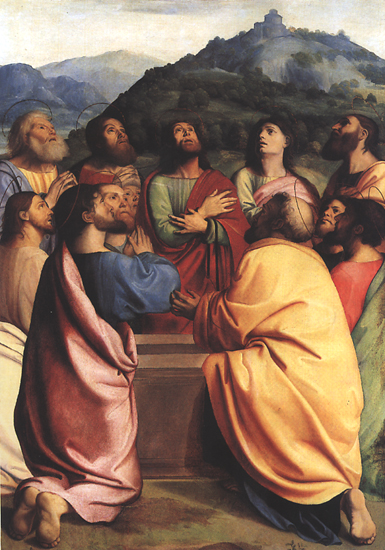
Alberto_Piazza_Apostoles_entorno_al_Sepulcro_Staatliche_Museen_Berlín

Apóstoles entorno al Sepulcro (“Apostles around the Grave”), by Albertino Piazza da Lodi [c.1520]

From the deeps I call out to you, O Lord; my Lord, hear my voice!
Let your ears be attentive to the sound of my pleadings. …
I await the Lord!
My spirit looks––and for His message I am waiting––
my spirit looks for my Lord
more than the watchmen for the morning, the watchmen for the morning.
            –from Psalm 130

Today is the Great Vigil, the feast which marks the end of the Lenten season.  For the last forty days, we have prayed and fasted to one degree or another.  We have acknowledged our own sin and mortality, remembered our need for forgiveness and redemption, and awaited the advent of our Messiah on His royal steed to save us from our distress.  Over the past week, the week of His holy Passion, we have grieved as the cheers of adulation turned to jeers of mockery.  We have stood by as a best friend betrayed Him with a gesture of feigned affection.  We have both pounded the nails into His hands and kissed His feet as He hung on the cross.  All this we have done, and tomorrow we will celebrate.  But today…

Today is Holy Saturday, the Great In-Between Day, the cosmic sabbath rest of Jesus Christ entombed in stone.  A friend of mine once whimsically reflected on this particular Saturday, saying that it always feels like “the deep breath before the plunge.”  The sentiment is fitting; today, the clockwork of the entire universe is held in suspended animation.  The Three Days (called “triduum” in the church-Latin) are days of activity: on Maundy Thursday, Jesus washes our feet, showing us the way of the cross and teaching us His new command to love and serve and sacrifice for His sake. Yesterday, on Good Friday, Jesus suffers the pain of our atonement, breaking His own body and pouring out His own blood, even unto death. Tomorrow, on Easter Sunday, Jesus rises from the dead and ascends to God in triumph.  Yesterday we despaired, and tomorrow we will exult.  But today…today is, well, in-between.

Today is also the seventh day, the day of rest.  It is a day of nothingness, of darkness and chaos, of anticipating the creative and re-creative work of God.  Tomorrow is a day full of life and light, when the Sun rises and fills all the earth with the knowledge and glory of God.  The ground will sprout forth its vegetation, the trees stretching out their hands in praise.  The sea, the air, the land, all teeming with swarming creatures, will revel in the beauty and grandeur of what God has done for us and with us.  And God will say that it is Very Good.  Tomorrow, God will speak out into our darkness, “Let there be light!”  But all of that is still Tomorrow.  For as long as it is called “Today,” it is not Day; it is Night.

Today, the deep covers the earth, and darkness is over the face of the waters.  Yet the Spirit of God hovers in the air, looking, yearning, groaning for the redemption of our bodies, of His body.  Can you see?  The days of creation and redemption and re-creation are all ordered alike: darkness, then light; evening, then morning; death, then life; for first comes the night, and afterward the dawn.

But the Resurrection is not yet come.  So we wait, our spirits looking for our Lord, more than the watchmen for the morning…

…the watchmen for the morning…


A Triptych of Light for the Triduum: Good Friday

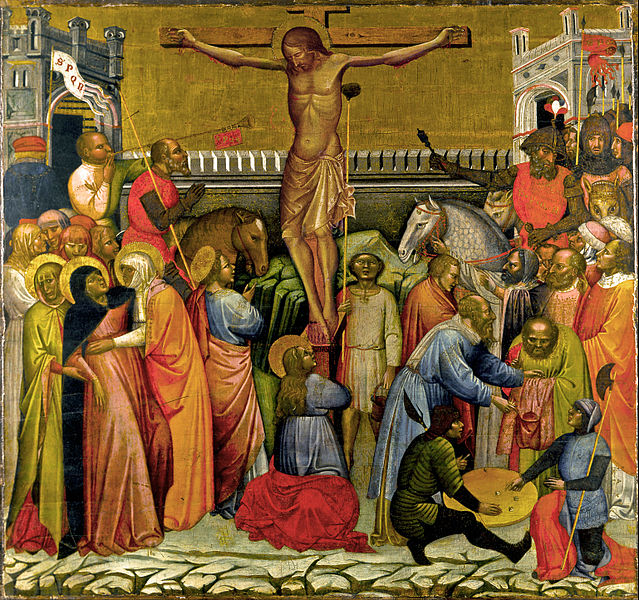
Jacobello_del_Fiore_Crucifixion

Crucifixion, by Jacobello del Fiore  [c.1400]

Be gracious to me, O Lord, for I am distressed;
my eye wastes away in grief, my spirit and my body.
My life is spent from sorrow, and my years from groaning;
my strength fails in my iniquity, and my bones are wasted away.
I have become a reproach to all my enemies––and to my neighbors especially––
and a dread to my acquaintances; those who see me in the street flee from me.
I am forgotten, like a dead man, out of mind;
I have become like an earthen vessel, destroyed.
For I hear the whispering of many, terror from all around in their scheming together against me;
they plot to take my life.
But me––on you I am trusting, O Lord; I am saying, “You are my God.”
The seasons of my life are in your hand;
rescue me from the hand of my enemies and my persecutors.
Shine your face on your servant!  Save me in your lovingkindness.
             –from Psalm 31

Yesterday’s meditation was quite cerebral; in contrast, this passage is exactly the opposite.  This psalm is sentimental, even visceral in its portrayal of emotions that we have all experienced.  But for today, let us not personalize this prayer with ourselves as the target.  It is tradition in the Christian religion to re-enact in our worship during Holy Week the events of Christ’s Passion––we wave palm fronds, wash each other’s feet, venerate Jesus on the cross, and hold vigil until his resurrection.  Today, I encourage us to take the imagination one step further, to transport ourselves back in time and participate in the events themselves.  We are the same crowd that chants both “Hosanna!” and “Crucify!”  So let us forget our lazy and fickle selves and rather seek to identify with Christ.

Let us plead with the Father to be gracious to Jesus as his spirit and body expire upon the cross.  Let us groan with sorrow at the reproach that Jesus endured from his enemies, and especially from his closest friends.  Let us lament that in his death Jesus has been forgotten, out of mind, by the very people he came to save––in spite of the fact he is indeed risen from the dead!  Let us hear the plotting and the scheming against his very life; and let us not raise our voices in protest but instead say…

Not my will, Father; but Your kingdom come, Your will be done.

Jesus trusted God his Father.  Let us also trust.  Jesus prayed, “You are my God.”  Let us also pray.  Jesus placed his life in the hand of his Father, truly and literally, even in the midst of a rejection and forsaken-ness that he had never known before.  The most intimate and everlasting fellowship of the Triune God was broken somehow during those few hours while Jesus hung on the cross.  Is it really so much for us to trust Him in the midst of our loneliness and pain?  Yes, it is so much: too much, in fact.  It was not too much for Jesus, but it is too much for us.  However, God’s grace is sufficient even for that.  In the end, all we can say is this:

Father, we beg You, please smile on us and save us in Your lovingkindness! 

So let us say it, together, today.  Then let us empathize with Jesus our Mediator, the one close to the Father’s heart, His one-and-only well-beloved Son, in whom He is well pleased.

A Triptych of Light for the Triduum: Maundy Thursday

William-Adolphe_Bouguereau_(1825-1905)_-_The_Flagellation_of_Our_Lord_Jesus_Christ_(1880)

The Flagellation of our Lord Jesus Christ, by William Adolphe Bouguereau [c.1890]

But he was pierced for our transgressions, crushed for our iniquities;
the punishment that gave us peace was on him, and by his wounds we are healed.
He was oppressed, and he was humiliated, but he did not open His mouth;
for he was cut off from the land of the living, stricken for the transgression of my people.
They placed his grave with the wicked, and with the rich in his death;
because he had done no violence, with no deceit in his mouth.
Out of his anguish he shall see light; he shall find satisfaction through his knowledge.
The Righteous One, my servant, shall justify many; and their iniquities he himself shall bear.
            –an excerpt from Isaiah 53 (emphasis added)

These words are worth contemplating as we memorialize once again the holy Passion of Jesus.  This is the very passage which the Holy Spirit used––via a series of extraordinary events that you can read about in the book of Acts, chapter 8––to introduce the Gospel to the continent of Africa several chapters ahead of the missionary endeavor to Europe (which does not commence until Acts 16).  On the return journey from Jerusalem to his own country, a man whom we know simply as the “Ethiopian eunuch” was reading this text and was confounded by the question, “Is the prophet here speaking of himself or someone else?”  Philip the Evangelist answered him by affirming that this passage speaks about Jesus the Messiah, the Suffering Servant of the book of Isaiah. One of the ways we know that this text is about Jesus is because of the word “light” which I have highlighted in the translation above.

In modern English, we use the expression “see the light” to communicate figuratively the idea of recognizing or realizing the truth.  But in ancient Israel, the expression “to see light” was used in a literal way to communicate the idea of being alive as opposed to either unborn or dead (see Job 3:16; Psa 36:10, 49:20).  In the book of Isaiah, the prophet takes great pains to communicate to the reader that the Suffering Servant will suffer, die, and be buried (v.10), but then afterward will be alive again and “see light.”  In other words, the prophet foretells the story of the resurrection of Messiah, not with a grand flourish but with a common figure of speech.  That is God’s way, is it not?  We might have missed it had not Jesus pointed out to his disciples (and the Holy Spirit to us) that the Hebrew Scriptures prophesied that the Messiah would both die and rise again.

Then Jesus opened their minds to understand the Scriptures; and he said to them, “Thus was it written for Christ to suffer and to rise again from the dead on the third day, and repentance for the forgiveness of sin to be proclaimed to all nations, beginning from Jerusalem.  You are witnesses to these things”  (Luke 24:45-48, emphasis added).

Yes, Jesus, we are witnesses.  Thanks be to God.

Jesus Christ: God from God, Light from Light, True God from True God; the Light of the World, prepared for all the world to see, for the enlightening of nations; He who descends into the earth like the sun and ascends into heaven with the dawning of a new day, a new age, a new covenant of peace between God and humankind.  By His light we see light.  By His wounds we are healed.  He who knew no sin was made sin for us, so that we might be made the righteousness of God in Him.  We eat His flesh, broken for us; and we drink His blood, the cup of our salvation.

For we proclaim the Lord’s death until He comes.

Meditation for the Feast of St Patrick

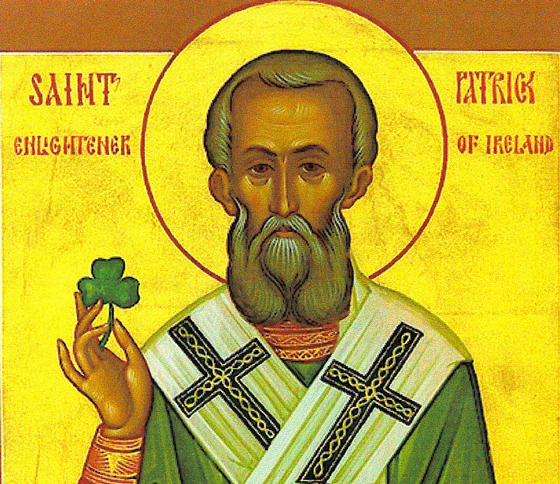
patrick

Icon of Saint Patrick, Enlightener of Ireland

“The Lord is my light and my salvation; whom shall I fear?
The Lord is the strength of my life; whom shall I dread?
One thing I have asked from the Lord, that will I seek:
to remain in the house of the Lord all the days of my life;
to stare at the beauty of the Lord, and to pray in his temple.
So I will offer in his tent sacrifices of joy;
I will sing and make praise-music to the Lord.”
– an excerpt from Psalm 27

The Lord is my light, writes the psalmist.  The phenomenon of light is one of the most primitive of all human experiences, yet we rarely give it a second thought except for when we need it.  The sun is one of the most dazzling of earthly wonders, yet it blinds us when we stare at it.  If in the modern age we were to take away the comfort of electrical technology, we would not be left with many other sources of light other than the sun.  Starlight doesn’t illuminate very much, and lightning only shines for a split second at a time.  Firelight is a little better, but still not very useful for the actual work of living.  Can you imagine trying to plow a field with a team of oxen by torchlight?

When considered from this perspective, one can understand why sun-worship was such a common practice in ancient cultures and yet a relatively rare practice today.  [Of course, we worship other idols––self, money, family, and the list goes on.]  It is truly remarkable that in ancient Israelite culture there existed a group of people who did not worship the sun but claimed instead that God was their “light.”  They claimed that this Divine Being, who created both the sun and the light, could not be seen or touched but that his Voice could be heard in some mystical way.  So let me ask you, who would worship a god like that when the sun makes itself available and perceptible each and every day, without fail?

Who could?  Surely, not us, blind sinners that we are.

Patrick of Ireland, whose feast we celebrate today, wrote strong words for those who worshiped the sun (see below).  Consider his reasoned argument: the sun is temporal and has no power; Christ, on the other hand, has ruled with the Father and the Holy Spirit for all eternity; therefore, worship Jesus.  He affirms that it is Jesus––not some delicate balance between the properties of physics that we call gravity and inertia––who commands the sun to rise each and every day.  But this is not a theological innovation on the part of bishop Patrick; no, he simply repeats what the Israelite prophets said of old (Gen 8:20-22; Job 9:7; Isa 45:7; Jer 31:35-37; Amos 5:8-9).  The psalmist goes a step further, however, declaring his desire to worship God not because it is rational––although it is that, since God has saved him, after all––but because it is pleasurable to “stare at the beauty of the Lord.”

Jesus takes this theological metaphor of light to its final conclusion when twice he says, “I am the light of the world” (John 8:12, 9:5).  In English, it’s a ready pun: not the sun, but the Son.  However, the truth of the matter is so much more devastating, for Christ is the “light” NOT because we are blinded when we look at Him, but because we are blind until we look at Him.  Jesus himself uses this exact conceptual wordplay: “For judgment I have come into this world; so that those who do not see might see, and the ones who see might become blind” (John 9:39).

Therefore, seeing the truth of these things, today let us offer a sacrifice of joy alongside Patrick our brother, and (literally!) sing and make praise-music to the Lord.  For He Himself is our Light and our Salvation.

     “For this sun which we now see rises each new day for us at his command, yet it will never reign, nor will its splendor last forever.  On the contrary, all who worship it today will be doomed to dreadful punishment.  But we who believe and adore the true sun that is Christ, who will never die, nor “will those who have done his will” but “abide forever, just as Christ himself will abide for all eternity”: who reigns with God the Father all-powerful, and with the Holy Spirit before time began, and now and through all ages of ages.  Amen.”
          –an excerpt from The Confession of Saint Patrick, translated by John Skinner (New York: Doubleday, 1998), p.75.

Must Jesus be called “Son of God” in a Bible translation?

Q: “I recently read an online article that describes how some Bible translations in Muslim-majority countries are not using the phrase “Son of God” (Grk. υιος θεου) because the concept is too easily rejected within the Muslim worldview. Instead, certain Bible translations are using the phrase “Beloved Son who comes (or originates) from God,” with much greater success in terms of the numbers of people reading the Bible and believing the Gospel. What do you think––is this a good or bad change in language for a Bible translation?

First of all, here is a link to the article being mentioned. It’s worth reading through, and I will write my response with the assumption that the reader is familiar with the contents. Second, I need to stipulate that there is a difference between theology (i.e. what is actually true about God) and language (i.e. how we say that which is true about God), and I would argue that theology transcends language. We as humans are limited by our bodies; that is, we cannot engage in theology except by using language, so there is considerable overlap between these things. But this does not blur the fundamental difference between the two, and that distinction is very important for the current question. We cannot “do theology” without using language, but human language cannot fully plumb the depths of theology. We are finite human beings who touch an Infinite Divine Being; or rather, He touches us.

The best answer I can give is that I believe both sides of this debate are correct. There is no such thing as an “equivalent” translation, languages are too complex for that. Any translation, of any kind, is a negotiation of the construals of conceptual worlds. This means that ALL translations require some level of negotiation between the two languages. So whether the term “Son of God” must be maintained in a translation really depends on what the translation sets out to do at the beginning. Not all translations are created equal. There’s lots more to discuss here, but the shortest answer is that both arguments are correct, depending on what “job” the translation is intended to do.

But speaking theologically, I think this debate really boils down to one thing. When Jesus said he was the “Son” of God, what did He really mean? I propose a thought experiment. Suppose an alien spacecraft landed in your back yard, and an alien came out, someone who had no frame of reference for understanding what the word “son” means. How would you explain to that alien what you mean when you say Jesus is the “Son of God”? Could you do it without using either your own father or your own son as examples, or are you as a human person bound by those biological realities in your linguistic communication? The issue is still a bit more complex than that, but I think the entire issue ultimately really is decided by that question.

Concerning the issue whether “Beloved Son who comes (or originates) from God” is acceptable over against the simple phrase “Son of God,” that depends on how strict the translation must be in terms of the rigorous of its faithfulness to creedal Trinitarian theology. Professor Horrell (quoted in the article) is correct when he affirms that the human father-son relationship is the closest thing we have in the physical world that can describe the relationship between Jesus and God the Father. However, we humans are made in the image of God, not the other way around. It is an error to think that the human father-son relationship communicates everything about the intra-trinitarian relationship between Jesus and the Father, because Jesus clearly says that he and the Father are one [whereas this is absolutely NOT true of human fathers and sons]. So the human father-son relationship is an incomplete analogy, but it’s the closest thing we have, and we cannot do without it. But at the same time, any kind of human linguistic expression is finally inadequate; we cannot truly understand a tri-personal being. We simply cannot; that’s all there is to it. So to answer my own thought experiment above, I affirm that our linguistic communication is genuinely bound by our biological realities, but our biological realities still fall short to express actual trinitarian theology.

But this theological question is really different than a translation question, because theology finally transcends Scripture alone. Scripture is merely one among a company of witnesses that profess theology — ultimately, our expression of theology must come from the incarnate Christ and not only the written Scriptures. Therefore, theology is like a globe that spins on three axes simultaneously: textual, i.e. it must be faithful to Scripture; historical, i.e. it must be faithful to the witness of Jesus Himself; and philosophical, i.e. it must express what is true and not what is false. So the question of what is acceptable in a Bible translation really is a linguistic issue more than a theological issue, although I would also confess that a Bible translation must not transgress the other witnesses (historical and philosophical) to proper theology. Take the Nicene Creed, for example. In theory, at least, the Nicene Creed could be superseded if the textual witness of Scripture, the historical witness of the Church, and the philosophical witness of human reason together demonstrated that the Nicene Creed does not accord with what Jesus proclaimed about God and about Himself.

So the bottom line is that all linguistic translations of Scripture are inadequate to express theology. The question is how much “inadequacy” is tolerable in any particular linguistic translation. In my opinion, there’s room for disagreement on this issue, depending on many, many factors. In the final analysis, I really think this is a *linguistic* issue more than a *theological* issue in the proper sense. But my personal opinion is that, both in the case of language and theology, the term “Son of God” must be retained, in spite of the difficulties it presents for other worldviews outside Christianity.

A creation theology…of sex?

Q:  My understanding of the Catholic theology of sex is that the only sex that is without sin is intercourse between a husband and wife that is “open to life” –– meaning that the only permissible means of birth control is having sexual intercourse only during a wife’s infertile periods.  What bothers me most about this teaching is that it may be true.  If so, this means that the use of condoms and/or a vasectomy as a means of birth control would be willful disobedience to the will of God.  I have a hard time determining whether or not this theological teaching is an articulation of God’s truth or a form of man’s legalism.  What does the Bible say?

Before launching into this issue, I want to thank this reader for asking such an honest and vulnerable question, and for giving me permission to post it here.  It is an honor to be asked this kind of ethical question of another person, something that I do not take for granted.  I want to honor the reader in return by offering the best answer I can.  Since this blog is dedicated to reading the OT and not to the particulars of Catholic theology, in this post I will not seek to argue either for or against the teaching of the Catholic church regarding sexual ethics.  But the reader here is quite correct that neither condoms nor a vasectomy are acceptable means of birth control as sexual ethics are defined in the Catechism of the Catholic Church (see ¶2370, p.629).  

[Note: I myself am Anglican, not Catholic, although generally I have a high regard for the ethical teachings of the Catholic church.]

Rather, my aim in this post is to investigate the perspective of the OT text in regard to sexual ethics, particularly in the creation narratives (i.e. Genesis 1-4).  In short, I’m seeking to answer the question, What is a creation theology of sex?  I will then apply the results of that theological investigation in order to provide some kind of answer to the question at hand.  But I need to offer a caveat that, in my opinion, there are many aspects of life and spirituality concerning which the Bible does not prescribe rigid laws.  God has created us as creatures of conscience, which is a gift of God to us to help us navigate life.  In my opinion, the issue of whether the specific Catholic teaching being referenced here is “an articulation of God’s truth or a form of man’s legalism” finally can only be answered by the married couple themselves in their relationship with God.

A creation theology of sex must start with Gen 1:26-28.

Then God said, “Let Us make humanity in Our image, after Our resemblance; and let them have dominion over the fish of the sea, and over the flying creatures of the heavens, and over the beasts and over all the earth, and over all the crawling creatures that crawl on the earth.”

     So God created the human race in His image;
     in the image of God He created it;
     male and female He created them.

And God blessed them. And God said to them, “Be fruitful and multiply, and fill the earth and subdue it; and have dominion over the fish of the sea, and over the flying creatures of the heavens, and over all the living creatures that crawl on the earth.”

In sum, there are three theological arguments to be made from this short paragraph of text concerning the human condition in regard to sexuality.  First, all humanity is created in the image of God, both male and female persons.  In other words, both masculinity and femininity together express the image and likeness of God. Neither masculinity alone nor femininity alone can suffice, and neither gender identity is more or less “divine” than the other.  Rather, it is the case that masculinity requires femininity, and femininity requires masculinity, both simultaneously, in order to fully express the image of God.  Second, the entire human race, both male and female, is blessed by God.  There is a sanctity to being human that extends beyond simply the fact of having been created.  As humans, we stand in a special relationship to God; even as sinners, we are not cursed.  The ground has been cursed, but we as people remain blessed simply on the basis of being human.  Thirdly, all humanity has an inherent obligation to our Creator to procreate for the purpose of filling and managing the planet Earth.  This is a collective responsibility to God that we bear as a human race, hence the human phenomenon of sexuality (in all its enormous complexity).

For each of us as human beings, our maleness or femaleness––although marred by sin–– is God’s creative design for our personhood.  We are engendered sexual beings because we are human beings, and to be an engendered sexual being is profoundly good and right and wholesome, in and of itself, with no qualifications, because we are blessed by God.  In other words, a person’s sexual identity intrinsically carries no shame whatsoever.  Period.  Full stop.  But we mustn’t end there, because the third axiom adds a dimension of purpose to our sexual identity as engendered persons.  Collectively as humans, God has created us as sexual beings to carry out a specific function in the world, that is, to procreate and manage the planet that God has entrusted to us to steward.  And if sexual identity is created for a specific function, then it is only natural that there could be limitations placed on sexual expression in order to ensure that its function is fulfilled. For example, let’s say I make a hammer for the purpose of driving a nail, but try to drive a screw instead. I could cause unnecessary damage because I have acted outside the inherent limitations of the thing that I have made.  These limitations derive from the intended purpose for which I, the maker, designed the hammer.

But there is still more to say about this notion of God’s expressed purpose/function for human sexuality.  This brings us to Genesis 2:24.

Therefore a man leaves his father and his mother, and clings to his wife; and they become one flesh.

Here the narrative is terse and does not explain what is meant by the term “one flesh,” but it is clear from Paul’s writings in the New Testament that he understands the term as a reference to sexual union (see 1 Cor 6:12-20).  So in addition to the procreating function of sexual expression that is explicit commanded in Genesis 1, there is also a uniting function for sexual expression that is implicitly stated in Genesis 2.  God has created sexuality as the means by which a man and woman both unite to each other and procreate with one another.  So far, so good, says the Catholic catechism.

But Catholic doctrine then takes this a step further, affirming that God has created these two functions for human sexuality as both universal and inseparable; and this makes all the difference for the question being asked.  Part Three of the Catholic catechism, entitled “Life in Christ,” includes a section on the “fecundity of marriage”:

¶2366.  Fecundity is a gift, an end of marriage, for conjugal love naturally tends to be fruitful.  A child does not come from outside as something added on to the mutual love of the spouses, but springs from the very heart of that mutual giving, as its fruit and fulfillment.  So the Church, which is “on the side of life” teaches that “it is necessary that each and every marriage act remain ordered per se to the procreation of human life.”  “This particular doctrine, expounded on numerous occasions by the Magisterium, is based on the inseparable connection, established by God, which man on his own initiative may not break, between the unitive significance and the procreative significance which are both inherent to the marriage act”  [Catechism of the Catholic Church, p.628].

The definitive element here is the phrase “each and every marriage act”––meaning sexual intercourse––which is NOT a quote from Holy Scripture but rather from the Catholic doctrinal document called Humanae vitae (Eng. “human life”).  Thus, the primary question being asked by the reader is whether the Catholic catechism is correct when it affirms that God has indeed created these two functions of sexuality as both existentially inseparable and universally applicable.  If so, then the Catholic doctrine is unassailable and must be followed in order to adhere to God’s natural law for human sexuality.  But if not, then there is room for varied application of these two functional principles.  So how can one evaluate whether the Catholic claims are indeed correct?

First, one should note that the Bible itself does not stipulate either the inseparability or universality of these two functions for human sexuality.  This decision is left to the reader, which may itself imply a kind of answer to the question; that is, perhaps this question is rightly considered a matter of personal conscience (similar to Paul’s advice in Romans 14 concerning the Christian observance of the Sabbath), which would of itself negate the absolute “universal applicability” of these functions. 

Secondly, the fact that the Catholic catechism specifically affirms that children are a “gift” from God also implies that perhaps the unitive and procreative functions of human sexuality are not quite as inseparable as the catechism states.  This seems reflected in the Genesis narrative itself, since the procreative function of sexuality is stated as an explicit command (Gen 1:28) whereas the the unitive function is stated as an implicit fact (Gen 2:24).  This would seem to indicate that the unitive function is a genuine constitutive reality of human sexuality––that is, that sexual expression serves to unite persons whether we like it or not.  But this is plainly untrue concerning the procreative function of human sexuality, because not all sex leads to procreation, as many people can painfully attest.

Thirdly, there are several instances in the Scriptures where the biblical writers as well as Jesus Himself affirm and emphasize the unitive function of sexuality as well as God’s desire that such a union should not be broken (see Gen 20:1-18; Prov 5:15-23; Mal 2:10-16; Matt 5:27-32, 19:1-12; Mark 10:1-12; 1 Cor 7:1-16).  However, I do not find the same kind of emphasis in Scripture concerning the procreative function.  The biblical writers seem quite concerned that married people should be faithful to one another and remain united to one another.  The biblical writers do not seem concerned nearly so much that married people should be producing children.  I think the biblical exegete can make a compelling case that God has created an imbalance in this functions for human sexuality, with greater importance on the unitive function but not to the negation of the procreative function.

In the end, I cannot specifically answer the question of the reader, whether the Catholic sexual ethic is divine truth or human legalism.  However, I think I can confidently say that the Catholic sexual ethic exceeds a biblical creation theology, i.e. it goes beyond what is expressed in the creation narratives.  But whether the Catholic ethic exceeds the bounds of natural theology (a.k.a. natural law) is quite another matter, one to which I must appeal to conscience.
“You had one job!!!”

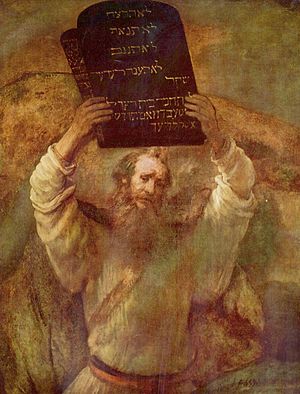
300px-Rembrandt_Harmensz._van_Rijn_079

Moses Breaking the Tablets of the Law, by Rembrandt Harmenszoon van Rijn [1659]

The series of God’s covenants in the OT tell a story.  As difficult as it is for us to admit, God’s covenant with Noah is about sin and judgment.  But there’s good news!––because God’s covenant with Abraham is about grace and faith.  Eventually, God redeems the Israelite people from slavery in Egypt, and God’s covenant with them (given through Moses) is about law and obligations.  That’s bad news for them, and for us, too.  The Israelites had one job, and they messed it up.  No one is able to meet the requirements for entering into covenant with God or for staying in covenant with God.  No, not even one.  But then God says, “Well, we’ll see about that…”

Suggested Reading: Exodus 17, 19, 34

Lecture: Moses, the Covenant Prophet [32 mins]

This lecture was recorded on 12 Mar 2016 at the Zion Evangelical Bible School in Khayelitsha, South Africa.


Where there’s smoke, there’s fire

Screen Shot 2018-04-02 at 8.12.19 PM

God’s Covenant with Abraham, by Jan Goeree & Abraham de Blois [c.1700]

In the OT, God appears in some peculiar and puzzling ways: in Genesis 15, as “a smoking oven and a burning torch.”  Why does God appear as smoke and fire in this story?  Truthfully, I have no idea –– and this is an important aspect of reading and understanding an ancient text that comes from a foreign culture.  There are many things that are unknown to us, many things that we can’t explain.  And it’s OK not to have all the answers to everything.  In fact, I believe that the mystery of the Bible is a central aspect of its enchantment and allure.  All that being said, however, what is important about God’s covenant with Abraham is not how God appeared but rather what God did when making the covenant with him.  As St Paul would explain many centuries later, God’s righteousness is not a paycheck––that is, payment for services rendered––but rather a gift freely bestowed on us when we believe God’s promise, no matter how improbable, or impossible, it may seem.

Suggested Reading: Genesis 15, Genesis 2-3

Lecture: Abraham the Covenant Patriarch [58 mins]

This lecture was recorded on 12 Mar 2016 at the Zion Evangelical Bible School in Khayelitsha, South Africa.

A literary smorgasbord

kushner_job_092712_620px
Job Rebuked by His Friends, by William Blake [1825] 

Lecture: A Brief Introduction to OT Literature [29 mins]

One of the main challenges for modern readers approaching the OT stems from the fact that the specific books come to us not as individual works but as a composite literary collection.  However, generally speaking, there is nothing in a standard Bible that signals the various literary genres that appear in either the OT or NT.  Rather, it is left up to the reader to decipher these for themselves.  In this lecture, I give an overview of the various kinds of literature in the OT and explain the rationale for the arrangement of the OT books in a standard published Bible.  I use the book of Job as a case study to explain why these factors are important for reading, understanding, and applying biblical literature.

This lecture was recorded on 13 Feb 2016 at the Zion Evangelical Bible School in Khayelitsha, South Africa.

When God begins a “relationship”…

Noah.thank.offering.2

Noah’s Thank Offering, by Joseph Anton Koch  [1803]

When we speak about the concept of “covenant” in the Old Testament, essentially we are talking about romance.  It’s a romance that includes the making of promises and giving tokens of pledge, symbolic gestures of love and faithfulness, and in some cases, even threats of punishment for infidelity.  A “covenant” in the Bible is rather like what we today call “marriage” –– with sexual overtones even if the specific covenant does not include sexual privileges.  One of the major narrative threads of the entire OT is God making a series of covenants with the Israelites, covenants that find their ultimate expression and fulfillment in the person of Jesus of Nazareth.

Lecture: An Overview of the Biblical Covenants [39 mins]

Eventually, I hope to begin an actual “podcast” (on iTunes and such) to stream audio content from this blog, but in the meantime, I will begin posting a series of lectures I gave in 2016.  These lectures cover major plot points and some literary features of the biblical narrative from Genesis through Nehemiah.  In this first episode, I offer a brief overview of the covenants of the OT and how they are fulfilled in Jesus.  This series of lectures was given to students at the Zion Evangelical Bible School in Khayelitsha, South Africa, as part of a four-year training program for pastors and church leaders.