Reading through Psalm 37 a while ago I saw a recurring theme that I had never observed before in all my readings of it. This theme revolves around the issue of land (presumably the land of Canaan, the land promised by God to Abraham for the Jewish people). I cannot help but wonder if Jesus was drawing on this psalm in the Sermon on the Mount (Matthew 5-7) in his teaching of the Beatitudes. Notice how the theme is woven beautifully throughout the song.
The psalmist introduces the concept early:
“Trust in the LORD, and do good; Dwell in the land, and feed on His faithfulness. Delight yourself also in the LORD, And He shall give you the desires of your heart.”
Psalm 37:3-4
This is just the beginning of a string of commands from the author to the reader, with exhortations to commit one’s way to God, rest in Him, not to fret, and to cease from anger. The psalmist gives the reason for all these commands:
“For evildoers shall be cut off; But those who wait on the LORD, They shall inherit the earth.“
Psalm 37:9
The psalmist continues in the next two verses to reiterate God’s promise that the wicked will receive their just comeuppance, and then reminds the reader that
“…the meek shall inherit the earth.“
Psalm 37:11
The psalmist continues in this elaborate contrast between the wicked and the righteous, once again revisiting the theme of land:
“The wicked borrows and does not repay, But the righteous shows mercy and gives. For those blessed by Him shall inherit the earth, But those cursed by Him shall be cut off.”
Psalm 37:21-22
Oh, and just in case we haven’t yet quite gotten the point, the psalmist caps it off:
“Depart from evil, and do good; [recall v.3] And dwell forevermore. For the LORD loves justice, And does not forsake His saints; They are preserved forever, But the descendants of the wicked are cut off. The righteous shall inherit the land, And dwell in it forever.“
Psalm 37:27-29
So what? What difference does this make today? It seems to me that the repetition of the idea of the land marks ideas that the psalmist meant to go together, namely these – righeousness, meekness, waiting on God, and God’s blessings (specifically eternal life). In other words, God is promising to bless us when we choose the path of righteousness by practicing meekness and waiting on God. But how do we do that?!? This brings us back to the opening paragraph of the psalm. We practice meekness in two ways: positively stated – by trusting in God, committing our life to Him, resting in Him, waiting patiently for Him; negatively stated – by ceasing from our anger and not worrying.
Q: I am a Christian and came across this documentary recently. Like most everyone these days, I’m interested in the issue of same-sex relationships, especially since this is a “lightning rod” issue within global Christanity right now. I know the traditional view of the Church, and I have read and continue to research the matter. I would like to deepen my understanding of this matter and apply it to how I live my life as a Christian. May I ask how you see this issue, and how did you come to that understanding?
Thank you for asking! I’m honored that you would ask for my opinion about this, I do not take it lightly. I hope that my response will demonstrate equal honor to you. First of all, before going any further, let me affirm you that I think you are wise to “deepen your understanding of the matter and apply it to how I live my life as a Christian.” Regardless of whether you are personally convinced one way or another about the issue, to approach conversations from a strident and rigidly dogmatic approach will probably not fulfill St Paul’s admonition to “if it is possible, as much as depends on you, live peaceably with all people” (Rom 12:18). And especially for people like myself who move in theological circles, we probably need to do much more listening than talking in any conversations we are involved in. Actually, that’s probably not bad advice for Christians as a whole.
I have watched the documentary, and I thought it was very well done! Although, certainly the video was advocating a particular position on the issue at hand. Homosexual expression within the Christian tradition is a very difficult issue, for all of the reasons that are given in the documentary. Most all of the exegetical points raised are valid, in my opinion. However, I would say that none of the arguments presented necessarily mean that the conclusion is correct.
To answer your question directly, I myself hold a traditional Christian view of sexual expression. Having said that, let me also say that I know people who are practicing Christians and practicing homosexuals. Personally, I am friends with astute theologians on both sides of this issue. I’ve spent a lot of time thinking about this topic, as have many Christians all around the world. I would add that this issue (as a theological issue, at any rate) is fairly confined to Protestant expressions of Christianity. In Catholic and Orthodox expressions of Christianity, there is very little discussion here (as far as I know, at least). According to my present understanding, both of those fellowships would denounce homosexual expression as not in accordance with God’s will, and would do so unapologetically. [For a brief description of the Catholic position, see Laudato Si, III.155 (pg. 115). You can visit this webpage to read a brief description of the Orthodox position.] My point here is that worldwide, I’m not sure there is quite so much movement to bless same-sex romantic relationships as often seems portrayed in Western culture(s). Yes, there are Christians who have changed their minds about this issue, but there are many Christians who have not.
Q: Are there any scholarly works that you feel help the modern church understand what Scripture says about this?
I personally have not come across much theological scholarly material on this topic, although I’m always looking for more, and I’ll gladly accept any and all referrals! I suppose that theological publishers are hesitant to publish books that deal with this issue, but that’s merely a guess on my part. This is a legitimate issue of theological debate right now, especially within the global Anglican communion. And there are some books that have been published about the issue of homosexual expression within Christianity, both for and against. Two popular books that were published a number of years ago are Wesley Hill’s Washed and Waiting and Matthew Vines’ God and the Gay Christian. Both of those books were written by Christians who identify as gay and come to different conclusions about homosexual expression within the Christian faith. But I would not regard either of these books as serious theological or exegetical works, nor do I think they were intended to be. Fundamentally, I think those are books about Christian spirituality and Christian living. Two other books that are more thorough are Karen Keene’s Scripture, Ethics, and the Possibility of Same-Sex Relationships as well as Sarah Coakley’s God, Sexuality, and the Self. However, I would venture to say that neither side has dug deep enough yet into the presuppositions of their own arguments. I think the global Church has a lot more work to do on this issue before it can be considered theologically “settled” to the satisfaction of modern Christianity.
Q: Hmmm…what do you mean by that?
Thanks for asking! Well, to explain myself there, I’ll need to back up a bit. So please bear with me on what might seem like a long-winded detour, but I’ll bring it back around. As the documentary points out very well, I think we should avoid drawing simplistic conclusions about a difficult issue and minimizing others with expressions like, “The Bible says that…”. I feel like Christians (especially in the evangelical world, where the Bible is held very highly) often don’t like to admit it, but the actual truth of the matter is that no one ever reads Scripture from an unbiased perspective. I suggest that EVERYONE is ALWAYS interpreting when we read the Bible. The Scriptures were written in languages that no one has spoken for centuries! We all come to the Scriptures as non-mother-tongue exegetes, so all of us are “second-language speakers,” at best. This necessarily means that there is a vast interpretive gulf between us and the original author/audience. We absolutely must acknowledge that if we are to handle the Scriptures responsibly and with any kind of intellectual honesty and integrity. So rather than saying things like, “The Bible says,” I think we are much wiser to say things like, “My understanding of the Scripture is…” or “I believe that the biblical author here means…”. Statements like these are much more honest about what is actually happening when we read and teach the Scriptures. And certain interpretations are more sound than others, to be sure. We should layer our theology accordingly.
But here’s the thing. The task of exegesis itself is not neutral. That is, we actually do bring our theology to bear on our exegesis, and we have no other choice in the matter (whether we admit it or not). For example, the Gospels record that Jesus held up a piece of bread and said, “This is my body” (Matt 26:26; Mark 14:22; Luke 22:19). How do you interpret what Jesus meant by that? Try as anyone might, I do not think there is any truly neutral way to exegete that statement. I submit that, in the end, a person must choose what they believe Jesus meant. Which means that it is not really an exegetical matter at all. It’s a theological matter. We believe what we choose to believe. And the same is true about exegesis as a whole. We interpret the Scripture according to whatever method(s) that we believe is the best, and that method affects our conclusions. We should not pretend to be more than we are as exegetes. Yes, our exegesis is, in fact, informed by our presuppositions about God and about truth. We are wise to own up to that from the very beginning, and then get on with doing the very best exegesis that we can.
Now, I’m not going to delve deeply into the Scriptural passages at play here. You (along with other Christians) can study the Scriptures for yourself and conclude what you believe in fellowship with the Holy Spirit and in accordance with Holy Scripture. But I will say this. If you read 1 Corinthians 6, which is perhaps the Pauline passage that deals most explicitly with sexual ethics, you should notice that St Paul does not treat sexuality as a moral code. That is, St Paul does not appeal to some moral law that condemns certain sexual practices but allows others. Rather, his entire moral argument proceeds something along this line: “You have been made one with Christ, so why are you sleeping with a prostitute?” (1 Cor 6:15). In other words, his sexual ethic is derived logically from our new identity in Christ and not strictly prescriptively from textual evidence. I think we are wise to pay attention to this. St Paul could have quoted OT passages to say that sleeping with prostitutes is wrong. But he did no such thing. Rather, he said (paraphrasing): “Hey, you’re one with Christ now! Why are you making yourself one with a prostitute?” Almost as if the expected reply is: “Of course! That’s just silly!” The fact that St Paul NEITHER appeals to prescriptive Scripture (as does the “heterosexual” camp, usually) NOR appeals to science or culture or knowledge (or any of the other things that the “homosexual” camp does) should be instructive to us, I think. That’s what I’m referring to when I say that I think the global Church has a lot more work to do on this issue before it can be considered theologically “settled.” I have yet to see theological or exegetical studies that (I think) sufficiently take into account the way that St Paul treats sexual ethics in Holy Scripture and then work it out in what I would consider a satisfactory way in modern Christianity.
Q: I’m not sure I fully understand yet. When you say, “We believe what we choose to believe, and the same is true about exegesis as a whole,” are you referring to situations where people choose material, techniques and sources to back up what they want to believe? Wouldn’t that deem this a futile exercise, especially when it comes to matters that are gray?
Right, I think you have understood me correctly. I’m suggesting that a person can start with a certain set of presuppositions about God and about truth and then exegete their way to concluding that homosexual expression is OK for Christians. Another person can start with some other presuppositions about God and about truth and then exegete their way to concluding that homosexual expression is NOT OK for Christians. If this is true (and I would say that is what is happening right now in the global Church), then the corollary that can reasonably be drawn is that perhaps this issue is not really about exegesis (i.e. what Scripture means) at all, but is rather about theology (i.e. what is true about God and about truth). If you listen carefully to the arguments presented in the documentary both for and against homosexual expression, I think you will find that they are not arguments about what Scripture means, but arguments about the nature of God and the nature of truth.
I further suggest that St Paul himself does not try to exegete his way to sexual ethics. In contrast, we should note that he DOES exegete his way to salvation theology in the book of Romans. So St Paul uses exegetical arguments sometimes, and sometimes not. And if he does not try to exegete his way to his sexual ethics, perhaps we shouldn’t try to do it, either. Essentially, he builds his sexual ethics by saying, “You’ve become one with Christ, so now what?” Perhaps we should do the same. Rather than approaching the issue from textual exegesis or from adherence to moral codes, perhaps we should approach the issue from the perspective of our new identity in Christ. I suggest that we should be asking, “Now that your body belongs to Jesus, what does He want you to do with your body?” The scary thing about this approach is that Christians might come to different conclusions, but that is happening already anyway. Regardless, I think Romans 8:5 (and surrounding context) is helpful here. I think it is clear that God wants Christians to live according to God’s Holy Spirit and not live according to their own flesh. And I think that advice is applicable to all Christians at all times in all places.
Q: OK, I think I’m beginning to understand, but I’m still not sure I’m following you completely. You mention that Paul does exegesis in the book of Romans, and one of the most difficult passages on this topic is Romans 1:26-27. By what you are saying, do you think Paul is exegeting sexual ethics?
No, I do not believe that St Paul is exegeting his sexual ethics in Romans 1. I would say that he is theologizing his sexual ethics. That is, he is assuming certain practices are “natural” and “unnatural” based on his presuppositions about God and about truth. St Paul is not exegeting an OT passage and saying on the basis of that passage, “Look! This OT passage means that homosexuality is unnatural and heterosexuality is natural.” I don’t think St Paul really starts exegeting OT passages until chapter 3, and he continues well into chapter 11. Again, I’m drawing a distinction between exegesis (i.e. what Scripture means) and theology (i.e. what is true about God and about truth). This is what I mean that I think sexual ethics in the church is not so much an exegetical issue as it is a theological issue. Or to say it another way, I’m not sure sexual ethics within the Church is rightly determined by what Scripture means so much as by what is true about God and about truth. Does that help?
Q: Yes, I see now, thank you for that. One final question. I know that there are some places in the world where civil laws are being considered to ban the practice of “conversion therapy” (that is, therapy with the goal of changing someone’s sexual orientation). Do you have any thoughts on that?
That is a very difficult question theologically, for many reasons. My general position is that I think it is usually a bad idea for the Church to get involved in political causes. In my opinion, it is almost always a distraction from our mission to preach the Gospel and to proclaim Christ and Him crucified. Also, I think it is wise for Christians to abide by civil laws when we can do so in good conscience. I am not a pastor, so I don’t have any specific pastoral experience with this issue. My personal experience is that I have seen examples of conversion therapy that appeared to fail and conversion therapy that appeared to succeed. Again, I think as ministers of the Gospel (as all Christians are) we can always encourage each other along the line that St Paul uses in his sexual ethic: “Now that your body belongs to Christ, what does God will for you to do with your body?” And in answering that question, I think we can always appeal to what St Paul writes in Romans 8, to live according to the Spirit and not according to the flesh. As a Christian and a scholar, I think that is the best perspective I can offer.
Q: Thank you for your thorough, considered, and very helpful responses.
It’s only a pleasure! Again, I’m honored that you would ask me. There’s no two ways about it, these are difficult issues with no easy answers. I pray that you and other Christians will be guided by the Holy Spirit of God as you minister the Gospel of Jesus to those around you.
Q: I’m wrestling with the phrase “on the other side of the Jordan,” which appears twice in Joshua 1:14-15. The way the expression בְּעֵ֥בֶר הַיַּרְדֵּ֖ן gets used most often leads me to translate it as a fixed expression naming a place (“Beyond-the-Jordan”), similar to בַּעֲבַ֣ר נַהֲרָ֔ה (“Beyond-the-River”) in Nehemiah and Ezra. As far as I can tell, when a geographic location is mentioned with this kind of expression, it is treated like a place name. Thus it wouldn’t be odd for Joshua to call it “Beyond the Jordan” even before crossing the Jordan. Regardless of what side of the river they are on, it always seems to be called “Beyond the Jordan” as distinguished from the Land of Canaan (the Promised Land proper). What do you think?
This is a difficult issue. I can see how it looks very much like the Hebrew phrase ֹעבר הירדן appears to be a proper name, like the phrase עבר נהרה common in the later OT literature. The question is, how do we know whether the phrase is a proper name or not? We have to look for contextual clues in places where the phrase appears. Of course, the first clue that this phrase might be different is reasonably apparent in that the absolute noun “Jordan” carries the Hebrew definite article. This isn’t a foolproof indicator, because sometimes in Hebrew the definite article does appear on proper nouns. And, in fact, the proper name “Jordan” very often takes the definite article, although not always. So this contextual clue is extremely inconclusive.
To gain ground here, we want to look for the most relevant contextual clues pertaining to all the instances of the term in question throughout the OT. For the current case study, I’ll identify the following four factors:
1) What preposition accompanies the Hebrew phrase (if any)?
2) What side of the river is being referred to? east, west, or ambiguous?
3) What accompanying geographical information is provided by the context?
4) Is the geographical area being referred to on the opposite side of the river from the author/speaker’s point of reference, or on the same side of the river from the author/speaker’s point of reference? Or is the point of reference unknown?
Based on cognitive science, we know that cognitive categories (including semantic categories) are organized according to prototype structures. [See George Lakoff’s book Women, Fire, and Dangerous Things (1987) for more information on cognitive categories and prototype structures in linguistics.] So what we are really after is to see, based on contextual clues, what kind of prototypical structures we can observe regarding the data pertaining to the phrase in question. If we can identify the prototypical structure for the meaning of this phrase, we’ll probably make significant progress toward understanding what this term really means.
Here is the raw data from the survey:
Reference
Hebrew Preposition
Directional Referent
Geographical Information
Point of Reference
Gen 50:10
בְּ
west?
land of Canaanites
unknown point of reference
Gen 50:11
בְּ
west?
land of Canaanites
unknown point of reference
Num 32:19
מִן
east
east/rising
same side as point of reference
Deut 1:1
בְּ
east
wilderness
unknown point of reference
Deut 1:5
בְּ
east
land of Moab
unknown point of reference
Deut 3:8
בְּ
east
Arnon, Mt Hermon
same side as point of reference
Deut 3:20
בְּ
west
generally conclusive
opposite side from point of reference
Deut 3:25
בְּ
west
generally conclusive
opposite side from point of reference
Deut 4:41
בְּ
east
sunrise
unknown point of reference
Deut 4:46
בְּ
east
Beth-Peor, Sihon
unknown point of reference
Deut 4:47
בְּ
east
sunrise
unknown point of reference
Deut 4:49
none
east
east/rising
unknown point of reference
Deut 11:30
בְּ
west
sunset
opposite side from point of reference
Josh 1:14
בְּ
east
generally conclusive
same side as point of reference
Josh 1:15
בְּ
east
sunrise
same side as point of reference
Josh 2:10
בְּ
east
Sihon, Og
opposite side from point of reference
Josh 5:1
בְּ
west
west/sea
unknown point of reference
Josh 7:7
בְּ
east
generally conclusive
opposite side from point of reference
Josh 9:1
בְּ
west
Great Sea, Lebanon
unknown point of reference
Josh 9:10
בְּ
east
Sihon, Og, Bashan
opposite side from point of reference
Josh 12:1
בְּ
east
east/rising
unknown point of reference
Josh 12:7
בְּ
west
west/sea
unknown point of reference
Josh 13:8
בְּ
east
east/rising
unknown point of reference
Josh 13:27
none
east
east/rising
unknown point of reference
Josh 22:4
בְּ
east
generally conclusive
unknown point of reference
Josh 22:7
מִן
west
west/sea
unknown point of reference
Josh 24:8
בְּ
east
Moab
opposite side from point of reference
Judg 5:17
בְּ
east
Gilead
opposite side from point of reference?
Judg 10:8
בְּ
east
Gilead
unknown point of reference
1 Sam 31:7
בְּ
east?
???
unknown point of reference
Isa 8:23
none
west?
Way of the Sea, Galilee?
unknown point of reference
First of all, we should note that this phrase almost always occurs with the exact same Hebrew preposition בְּ (“in, at, by”), which is the preposition that one would expect. The preposition מִן (“from”) is used in two instances that specifically discuss from where a particular group will receive their inheritance, and it is not readily apparent why the preposition is omitted in three instances. The point is that there is probably not very much to be gained semantically from the selection of preposition for this particular term. So we can move on to the next column of data.
Secondly, we should note that the phrase clearly can refer to either the east side of the Jordan or the west side of the Jordan. Also, it is almost always conclusive which side is being referred to in any given instance. Out of the 31 attestations, only 4 are ambiguous, and two of those (in Gen 50) probably refer to the west side of the Jordan because of the mention of “Canaanites” in the immediate context. So even if we don’t necessarily know exactly what the specific phrase actually means, we almost always know what the phrase physically refers to. This is extremely helpful to our task.
Thirdly––in tandem with the above paragraph––we can see fairly plainly that the specific side of the Jordan being referred to is almost always either (a) explicitly specified by the narrative or (b) implicitly conclusive from the narrative context. The fact that several instances of the term are explicitly specified as either east (toward the “rising,” i.e. of the sun) or west (toward the sea) is a significant clue that this phrase by itself is probably not conclusive for a particular region (either west or east of the Jordan river). [As an aside, this is a huge clue that supports the conclusion that this phrase is NOT a proper name, like עבר נהרה, which always refers to the region on the west side of the Euphrates river.] In other words, if the naked phrase עבר הירדן was always conclusive to the reader regarding which side of the river was being described, then the author probably would not include modifiers to specify which side is being referred to in any given case.
Fourthly, we should note that most of time the specific point of reference of the author/speaker is unclear. However, in cases where we know the point of reference for the biblical speaker, the term more often refers to the opposite side of the river from where the speaker is standing. So the phrase has potential to mean either the “same side” or the “opposite side,” but it most often refers to the “opposite side.” So the “opposite side” sense of the term is probably more prototypical than the “same side” sense of the term.
Finally, we should notice that the vast majority of instances where the phrase occurs refers to the east side of the Jordan, that is, the other side of the Jordan from the defined land of Canaan (i.e. on the west side of the Jordan). And now we can start to get a reasonable picture of what this phrase means and how it was probably used by the OT authors. Most likely, the most basic and prototypical sense of the phrase probably is, “the other side of the Jordan.” For an ancient Israelite, most people would probably use this phrase while they themselves were on the west side of the Jordan as a way of referring to the east side of the Jordan. However, if an ancient Israelite were on the east side of the Jordan, they could also use the same phrase to refer to the west (i.e. opposite) side of the Jordan. It is not too difficult to imagine, then, how the phrase could also absorb an additional sense of “the same side of the Jordan,” especially if there wasn’t a good word readily available in Hebrew that meant “same side.”
So to bring this to a translational outcome, I think one is on safe ground to translate this phrase as either “the other side of the Jordan” or “this side of the Jordan” in places where the point of reference is known. The challenge comes in those places where the point of reference of the author is unknown. There are a few options, all of which are employed by modern translations in various places. One could specify either “eastward” or “westward” on a case-by case basis. One could make an educated guess at the point of reference depending on the narrative context and then translate accordingly. One could also apply some kind of standard default position: unless contextually specified, “this side” will refer to the west, and the “other side” will refer to the east. In many instances, modern translations do not specify and simply translate the phrase as “beyond the Jordan”––which is a safe translation, but it also leads one to ask the very question at the beginning of this post!
Éomer and Aragorn leant wearily on their swords. Aragorn looked at the pale stars, and at the moon, now sloping behind the western hills that enclosed the valley. ‘This is a night as long as years,’ he said. ‘How long will the day tarry?’ ‘Dawn is not far off,’ said Gamling, who had now climbed up beside him. ‘But dawn will not help us, I fear.’ ‘Yet dawn is ever the hope of men,’ said Aragorn.
J.R.R. Tolkien, ‘The Two Towers,’ from the chapter Helm’s Deep (as below)
Pause. Dawn is ever the hope of men. So says Aragorn, at least, and since Aragorn says it in this way, Tolkien probably would have said it, too. It’s a statement worth contemplating. I’ve taken the liberty to compress the conversation, but this dialogue takes place during the night of the battle of Helm’s Deep, shortly before daybreak. This battle is a decidedly human struggle, a kingdom of men defending itself against destruction by the forces of evil. Aragorn does not say that dawn is the hope of Elves, Dwarves, or Valar, nor does he say that dawn is the hope of Birds and Beasts. Dawn is ever the hope of Men. Of course, he means that dawn is the hope of women, too. But why the stubborn hope, Aragorn? And what’s so especially human about the dawn? Hmmm, let’s continue…
At last Aragorn stood above the great gates, heedless of the darts of the enemy. As he looked forth he saw the eastern sky grow pale. Then he raised his empty hand, palm outward in token of parley. The Orcs yelled and jeered. ‘Come down! Come down!’ they cried. ‘If you wish to speak to us, come down! Bring out your king! We are the fighting Uruk-hai. Bring out your skulking king!’ ‘The king stays or comes at his own will,’ said Aragorn. ‘Then what are you doing here?’ they answered. ‘Why do you look out? Do you wish to see the greatness of our army? We are the fighting Uruk-hai.’ ‘I looked out to see the dawn,’ said Aragorn. ‘What of the dawn?’ they jeered. ‘We are the Uruk-hai: we do not stop the fight for night or day. We come to kill, by sun or moon. What of the dawn?’ ‘None knows what the new day shall bring him,’ said Aragorn. ‘Get you gone, ere it turn to your evil.’
Again, pause. Essentially, the Orcs ask the very question I have already posed: What of the dawn? I find Aragorn’s response amusing yet trite (paraphrasing now): “Well, you never know, you might lose? Better leave before that happens!” This is no satisfying answer, and the Orcs know it. But Aragorn continues…
‘Depart, or not one of you will be spared. Not one will be left alive to take back tidings to the North. You do not know your peril.‘
Ironically enough, immediately after saying this, Aragorn runs back in retreat because the Orcs blast away the gate above which he was standing. So Aragorn does not promise the Orcs defeat because he himself is winning the battle. In fact, he is not. Nor, it seems, does Aragorn promise the Orcs defeat because he knows that there is an army of Huorns coming up from behind them (although there is, as it turns out). If Aragorn did know that, then presumably he would have said to the Orcs something like (again, paraphrasing): “Hey guys, look behind you. The Huorns are coming!” He says nothing of the sort. Yet Aragorn is so confident of victory that he comes out on the wall to parley, that is, to offer the Orcs a chance to leave peacefully before they are slaughtered.
What?!?
Thoughout the entire episode, Aragorn appeals to the hope of the dawn, and I think we are meant to take him at his word. Aragorn hopes because he sees the sun rising, even though he does not yet see the sun. It’s the dawn. Dawn is ever the hope of men.
It’s not just imagery. It’s magic.
* ~~~~~ * ~~~~~ *
But what if…
What if it were true?
What if the magic of the dawn is not mere fantasy, but reality?
What if the sunrise we see every day is not just a function of bodies acting according to laws of planetary motion?
What if the dawn is, in point of fact, a function of heavenly lights obeying the very voice of God commanding them day after day after day, until the end of time?
That’s what the Bible says. Listen to it:
Thus says the Lord–– who gives the sun for light by day and the statute of the moon and stars for light by night, who stirs up the sea, and its waves roar–– the Lord of Hosts is his name: “If these statutes depart from before me,” says the Lord, “then also the seed of Israel will cease from being a nation before me forever.”
Jer 31:35-36
And the Lord smelled the pleasing aroma, and he said in his heart: “Never again will I curse the ground any more for the sake of humankind, for the intention of the heart of humanity is evil from youth. And never again will I smite any more every living thing, as I have done. For all the days of the earth: seedtime and harvest, and cold and heat, and summer and winter, and day and night, they will never cease.”
Gen 8:21-22
Cold scientific reasoning would have us take the dawn for granted, writing it off as the immutable laws of physics operating within our solar system. But the magic of faith would have us reckon the dawn as the daily renewal of God’s covenant with all creation. Read the above passage from Genesis 8 again. Note that this covenant is marked especially by God’s gracious forbearance with human violence and sin––problems that do not get better after the flood, mind you!––a covenant sealed with the promise of a rainbow.
“What of the dawn?” the Orcs ask. The Bible answers: The dawn is God, every morning, saying anew, “Let there be light!” And there is light.
It’s not darkness. It’s light. Because God is light. It’s not science. It’s magic. Because God commands it. It’s not law. It’s covenant. Because God always keeps His promises. It’s not evil. It’s good. Because God is good.
What if God ever fell down on the job? got sick and was laid up in bed? took a day off?
What if God got a sudden attack of laryngitis? gave the sun and moon the silent treatment? got grumpy and just decided not to talk that day?
What if God ever broke his promise? What if, at bottom, God isn’t good?
What if, one day, the sun just happened NOT to rise?
What then?
No, really…what would happen?
* ~~~~~ * ~~~~~ *
Arise, shine, for your light has come, and the glory of the Lord has [dawned] upon you. For behold! darkness covers the earth, and thick darkness the peoples; but upon you the Lord is [dawning], and his glory is seen over you. Nations shall come to your light, and kings to the brightness of your [dawn].
Isa 60:1-3
I’ve taken another liberty here, in that I have translated the specific Hebrew verb “to rise” into English using the contextually specific term, “dawn.” I’m convinced that’s the image that the Prophet is painting here, as attested by other modern English translations as well. These are words of hope, addressed to the people of God living in Jerusalem. But notice…who is the sun in this word picture? Who is the light that has come, that can be seen rising in the sky above Jerusalem? It’s God, the Lord himself! Now hold that thought…
He was the true light, the one who shines on all humankind, coming into the world. He came to his own, and his own did not receive him. But whoever did receive him, to them he gave authority to become children of God, to those who believe in his name.
John 1:9,11-12
Therefore, again Jesus said to them, “I am the light of the world; the one who follows me shall not walk in darkness, but shall have the light of life…For judgment I have come into this world, so that those who do not see may see, and those who do see might become blind.”
John 8:12, 9:39
These words of Scripture are familiar to the Christian, and rightly so. So familiar, in fact, that I think we as modern readers often take for granted the image being used here, both by the Evangelist (writing the Gospel account) and by Jesus himself. What is the light of the world? It’s a common concept in ancient Near Eastern literature, and any first-century Jew would have known immediately the answer: the sun. The sun shines on all humankind. The sun provides the earth with the light of life. The sun is the light that enables us to see––enough to do productive work, at any rate; can you imagine trying to grow food without sunlight?––yet the sun can, quite literally, blind us.
Do you see the clever wordplay Jesus employs? He compares himself to the sun, which can either illuminate or blind. Jesus freely offers himself as the light of life to all humankind. But the ancient Jew, culturally steeped in the literature of the Old Testament, would have understood the astounding claim Jesus implicitly makes here. In comparing himself to the sun, Jesus equates himself with the Lord, the God of the Old Testament. The light imagery in the Gospels is shot through with the sun imagery found in the Hebrew prophets, especially Isaiah. The ancient Israelites anticipated that God would one day come dwell on earth with humankind, and they saw the dawn as an expression of this hope. Dawn is ever the hope of men. Then Jesus arrives on the scene and proclaims, “Here I am!”
* ~~~~~ * ~~~~~ *
This is a night as long as years. How long will the day tarry?
Have you ever spent a night like that? I know you have, and so have I. Perhaps you are in the midst of such a night right now. If not, you will be soon. After all, nights are as regular an occurrence as days. In this life, the night is never far away. Sooner or later, every one of us passes through seasons where all we can pray is, “O Lord Jesus!” If we can pray at all, that is. The Scriptures tell us that darkness covers the nations, and thick darkness the peoples. Surely you have felt it! You don’t need me to tell you that it’s the truth.
But there’s another truth, too. His name is Jesus – the only Son of God, eternally begotten of the Father, God from God, Light from Light, true God from true God. He shines in the darkness, and the darkness cannot overcome Him (John 1:5). The Scriptures also tell us that weeeping may endure for a night, but joy comes in the morning (Psa 30:5). Surely you have felt that, too! How? Why? God created the heavens and the earth and the universe, evening then morning (Gen 1:5). The order is intentional, so that we might know that first comes the night, but afterward the dawn. For the one who believes in Jesus, the rising of the sun each day is the harbinger of eternity, the sign of the promise of resurrection, the guarantee that evil and darkness will not, in the end, prevail. Because when we look out to see the dawn each new day, we know that God has kept his promise yet again. The sun came up this morning, did it not?
Dawn is ever the hope of men.
The magic of Aragorn’s dawn is not only fantastic literary imagery. It’s the real truth. I think that’s the whole point that Tolkien was trying to make, and Jesus, too. We hope because we see the Son rising, even though we do not yet see the Son.
But one day…
A Prayer for the Dawn:
This is another day, O Lord. I know not what it will bring forth, but make me ready, Lord, for whatever it may be. If I am to stand up, help me to stand bravely. If I am to sit still, help me to sit quietly. If I am to lie low, help me to do it patiently. And if I am to do nothing, let me do it gallantly. Make these words more than words, and give me the Spirit of Jesus. Amen.
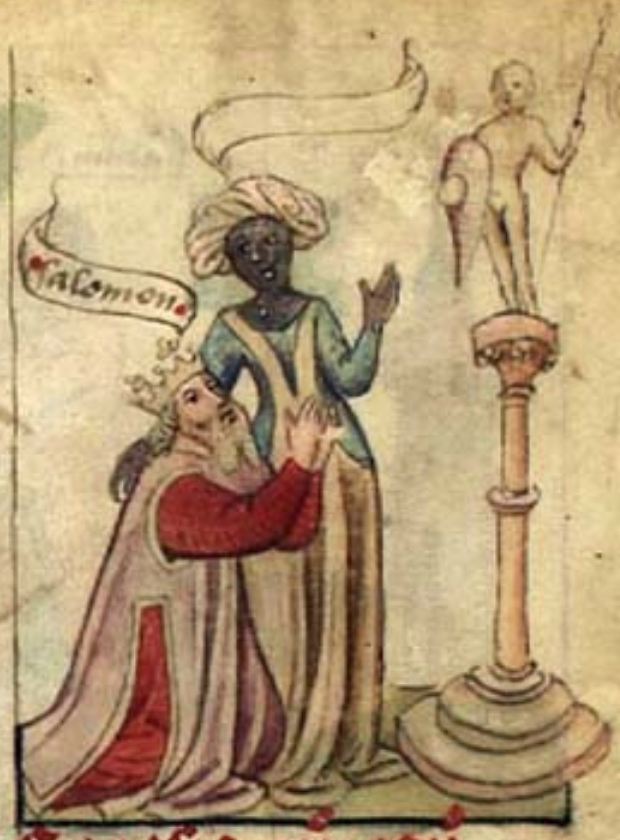
King Solomon and the Queen of Sheba, from a manuscript of Speculum Humanae Salvitionis [c.1430]
Of course, many, many people are aware of the “Ten Commandments.” But did you know that, in the Old Testament, God also gave “Ten Guidelines” specifically for the king of Israel? It’s true! You can find them in Deut 17:14-20. [And really, it’s not bad advice for anyone, even in modern times!] In the books of Kings in the Old Testament, all of the kings receive an evaluation: either he “did what was right in the eyes of Yahweh” or he “did what was evil in the eyes of Yahweh.” Have you ever wondered what the actual “measuring stick” was for these pass/fail judgments?
[The lecture is not accurate in one aspect…there are eight good kings of Judah instead of five. I missed Joash, Amaziah, and Jotham.]
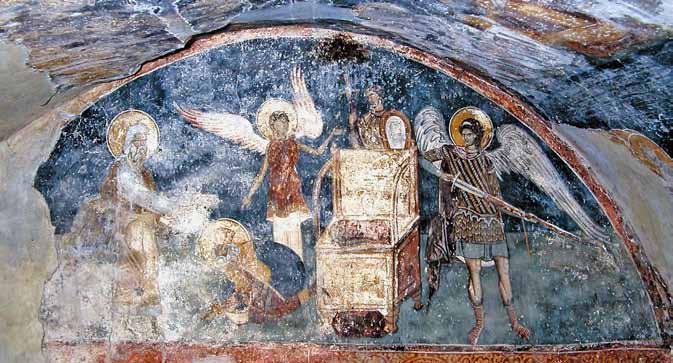
The Repentance of King David, at The Church of St. Sophia in Ohrid, Macedonia [c.1345]
Yes, in some ways, King David was worse than King Saul, and he reaped what he sowed. But he repented. And that’s the whole point of being “a man after God’s own heart.”
Confession, not excuses. Repentance, not perfection. Absolution, not judgment. Still, the consequences of all of our actions remain. Because God is perfectly righteous and just, and yet, his nature is always to have mercy…
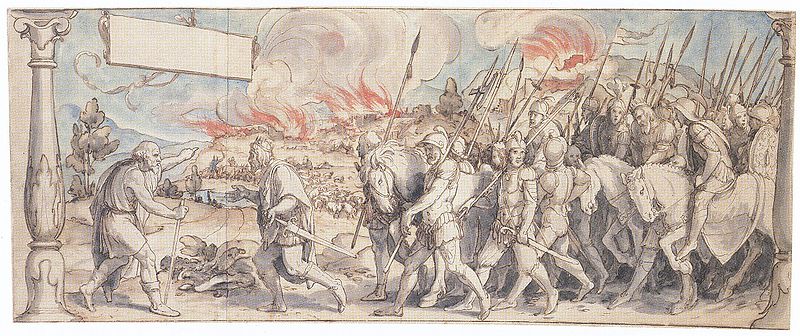
Samuel Cursing Saul, by Hans Holbein the Younger [c.1525]
So the Israelites leave Egypt and come to the land they would eventually claim as their own, scratching out a living as a confederation of tribes with no central government. The book of Judges ends with a somber analysis of this state of affairs: “Each person did what was right in their own eyes.” The people bellyache for a king, so God gives them a king; naturally, the guy who is head-and-shoulders taller than everybody else. Things go from bad to worse. God predicts that the king will let his power go to his head, and that’s exactly what happens. So eventually, God says that He will choose a new king…
…except that king does some even worse things than the first one. What ARE you thinking, God?!?
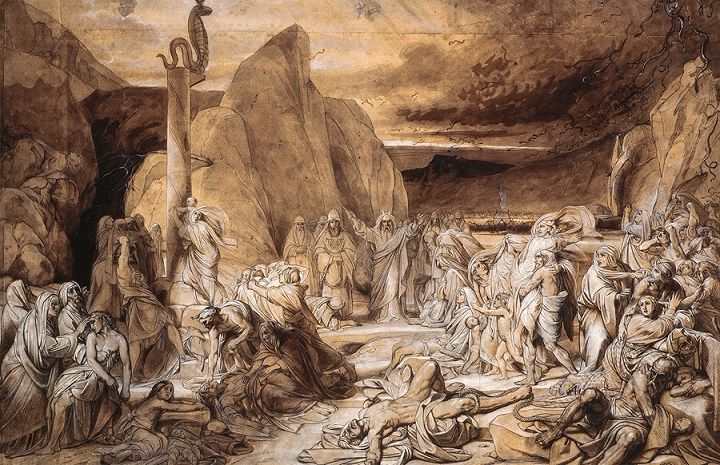
For the Christian, there are some moments of utter beauty in the Old Testament where the atoning death and/or victorious resurrection of Jesus is prefigured with astounding clarity. The story of the bronze serpent on the pole in the wilderness is one of these vignettes. But the story doesn’t stand alone; rather, it comes at the end of a series of episodes which transpire while the Israelites are on the 40-year trek through the desert from Mt Sinai to the Plains of Moab. Those who walk a journey of faith with God sometimes say, Believing is Seeing, a play on words of the popular modern sentiment, Seeing is Believing. But for those Israelites, to see the elevated figure on the wooden apparatus really was to believe: “Yes, that is for me!”
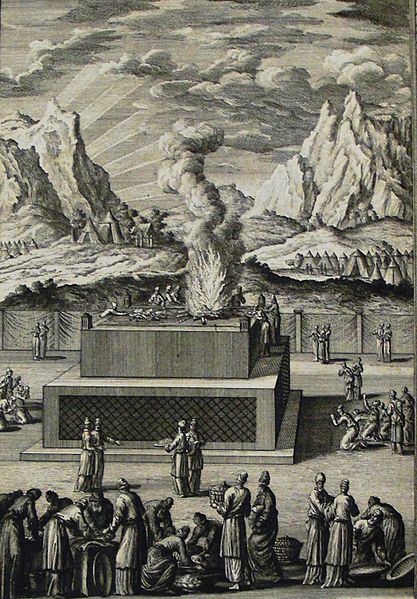
Burnt Offering, by Phillip Medhurst [1970] from the Collection of Bible Illustrations, CC by-SA 3.0
In the ancient Israelite sacrificial system, God commanded the Israelites to offer burnt offerings as a “sweet-smelling aroma” to Him. Which works just fine if burning incense, like the priests did inside the tabernacle, on a specific altar for this very purpose. But that’s not what a “burnt offering” was. A burnt offering was where a cow (or some other animal) was burned with fire on the huge altar outside of the tabernacle. And when you burn meat in a fire, it doesn’t smell sweet at all. In fact, it stinks. Clearly, God has lost His marbles…or perhaps not?
Q: Does the “pillar of cloud” actually turn into fire in Exo 14:20, as the New Living Translation states? I’m confused, because other translations don’t say that. What is going on there?
Here is how Exo 14:20 reads in the New Living Translation (NLT):
“The cloud settled between the Egyptian and Israelite camps. As darkness fell, the cloud turned to fire, lighting up the night. But the Egyptians and Israelites did not approach each other all night.” Exo 14:20, NLT
In my opinion, the NLT is a clear over-translation of the Hebrew text in this verse. It could very well be that the author intends to describe that the cloud turns into fire, but we don’t know for sure from the Hebrew text that is there. Here is how I would translate Exo 14:20 in a very literal way (pay attention to the textual notes):
And [the pillar of cloud] came between the camp of Egypt and the camp of Israel. And the cloud was there with the darkness*, and [the cloud] shone with the night**, and neither came near the other all the night.
* or perhaps “and there was both cloud and darkness”
** or perhaps “and lit up the night”
It is clear from the Hebrew text that the cloud produces light somehow. Given the overall context of the entire exodus narrative––where the pillar is a cloud during the day and fire during the night––it makes complete sense that “the cloud turning to fire” is exactly what happened that night. But I think it’s too much to say that the Hebrew phrase there definitively means that the cloud turned to fire.
I understand the Hebrew text in the same way as the New International Version (NIV), which starts the sentence back in v.19. The NIV states that the theophanic cloud produced light on the Israelite side and darkness on the Egyptian side.
“The pillar of cloud also moved from in front and stood behind them, coming between the armies of Egypt and Israel. Throughout the night the cloud brought darkness to the one side and light to the other side; so neither went near the other all night long.” Exo 14:19b-20, NIV
This verse contains a Hebrew word that could be either the preposition “with” (shone with the night, as per my translation above) or a particle that marks the direct object of a verb (lit up the night, as per the alternate text in my textual note). For a couple different reasons, I think it makes much better sense to read that word as a preposition. I’m pretty sure that’s how the NIV translators understood it, which (I think) is how the NIV gets the “darkness on one side, light on the other” idea. I myself feel reasonably confident that the story is saying that, on that particular night, the pillar was dark on the Egyptian side and light on the Israelite side. Perhaps the pillar was both cloud and fire at the same time? We don’t really know for sure, but it’s fun to imagine!


 Reading the Old Testament